
In the first three quarters of this year, 137,229 second-hand residential properties were signed online in Beijing, a year-on-year increase of 5.1%, and the transaction scale was the highest in the same period since 2022; in Shanghai, 191,563 second-hand residential properties were signed online, a year-on-year increase of 15.5%. Since the third quarter, the monthly transaction volume has hit a new high for the same period in the past five years for three consecutive months.
In October, the second-hand housing market continued to be active.As of October 20, 7,029 second-hand residential units in Beijing and 14,174 second-hand commercial housing units in Shanghai were sold respectively, a year-on-year increase of 25.9% and 37.9%.
On the whole, transactions in the Beijing-Shanghai second-hand housing market remain active, with rigid demand still accounting for the majority of transactions and improving demand showing a marginal recovery.However, the price performance of the two places is somewhat different: Shanghai’s second-hand housing listing prices have stabilized, while Beijing’s listing prices still have downward pressure.Whether subsequent improvement demand can be continuously released, and whether the rebound in transactions can further drive price stabilization, remains worthy of attention.
1. Second-hand housing transactions in Beijing and Shanghai remain active, with price trends diverging
The second-hand housing market transactions in Beijing and Shanghai continued to increase. In the first three quarters, 137,000 and 192,000 second-hand housing units were sold in Beijing and Shanghai.Driven by the continued effective effects of demand-side policies in August, the Beijing-Shanghai market remained active. In September, second-hand housing transactions in Beijing and Shanghai were 16,000 and 21,000 units, respectively, an increase of 13.7% and 2.0% month-on-month. Shanghai increased by 17.6% year-on-year, marking seven consecutive months of year-on-year growth. Beijing decreased slightly by 0.5% year-on-year.
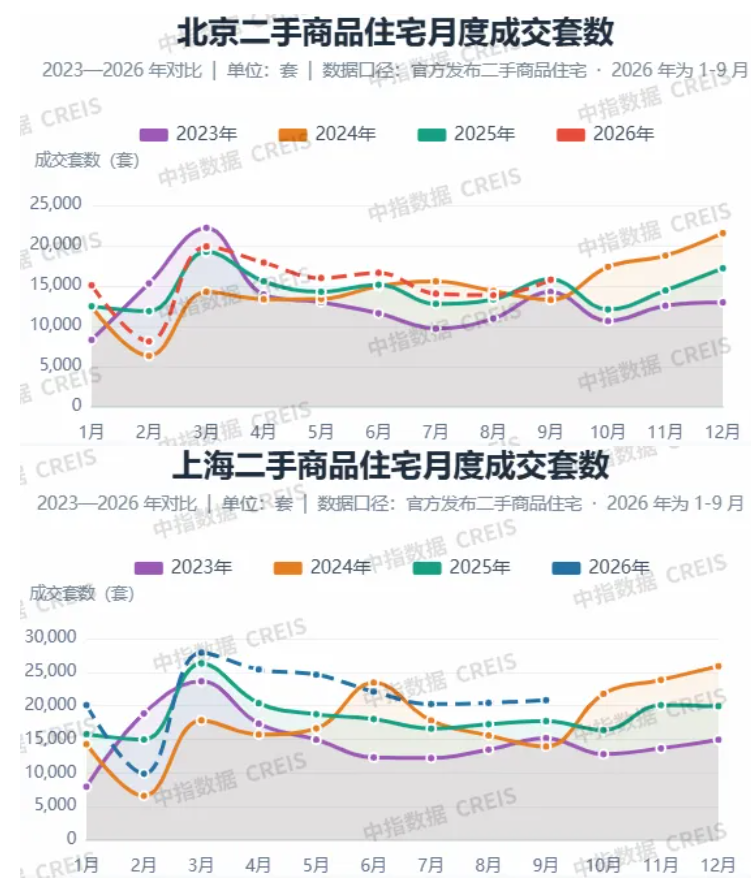
In terms of price, according to the China Real Estate Index System Hundred Cities Price Index, the price of second-hand housing in Beijing fell by 5.32% in the first three quarters of 2026. The average listing price in Beijing is still declining. The decline narrowed in the second quarter and expanded in the third quarter. Shanghai’s second-hand housing listing prices have shown an overall upward trend since March. They continued to rise month-on-month from March to July, fell slightly in August, and rose again by 0.11% in September.
2. Rigid demand is still the main force in second-hand housing transactions in Beijing and Shanghai, and improvement demand has recovered
In the first three quarters, the proportion of second-hand housing transactions of less than 2 million yuan in Beijing and Shanghai accounted for 51.3% and 47.1% respectively, an increase of 3.1 and 5.0 percentage points compared with last year.From the perspective of area segment, there is also a trend of concentration of transactions towards small units. In the first three quarters, the proportion of second-hand housing transactions of less than 90 square meters in Beijing and Shanghai accounted for 62.5% and 66.6% respectively. Shanghai increased by 1.7 percentage points compared with last year, and Beijing was basically the same as last year.
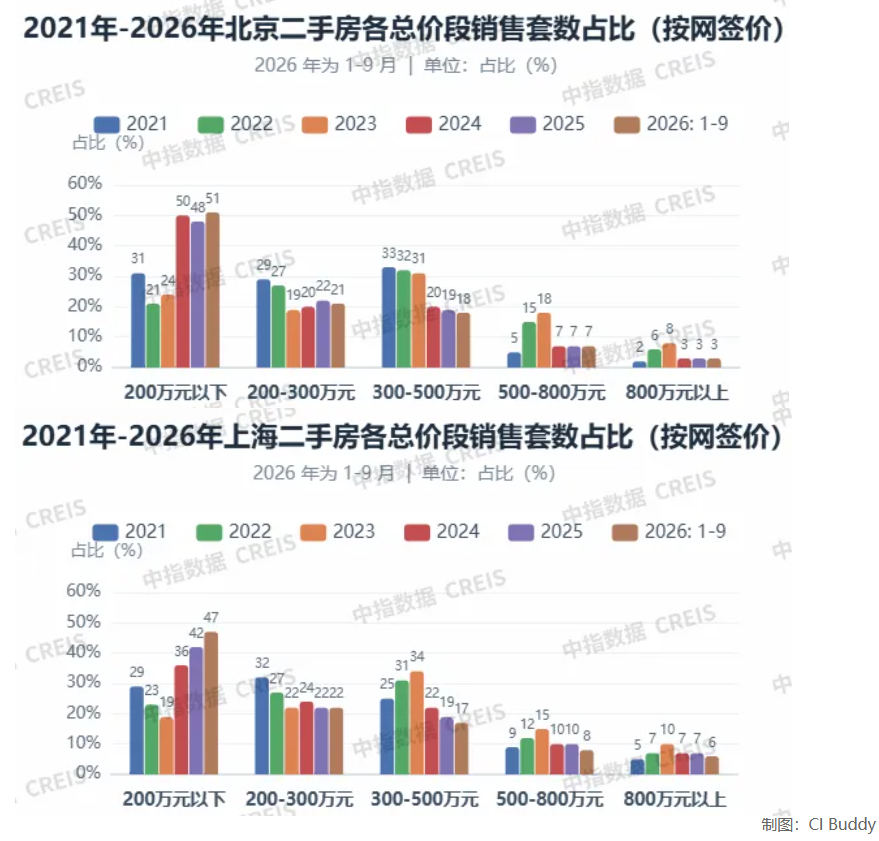
At the same time, since May, the proportion of second-hand housing transactions of more than 3 million yuan and more than 90 square meters in Beijing and Shanghai has increased compared with April this year, reflecting the recent improvement in the transaction structure and the recovery of some improving demand.
In September, Beijing’s proportion of transactions for housing listings priced at more than 3 million yuan increased from 20.9% in April to 30.9%, among which the proportions of transactions priced at 3 to 5 million yuan, 5 to 8 million yuan and 8 million yuan or more increased by 4.6, 3.4 and 2.1 respectively.percentage points; the proportion of Shanghai’s high-priced housing transactions is also on the rise, with the proportion of transactions for properties above 3 million rising to 33.2%, of which the proportion of transactions for properties between 3 and 5 million has increased to 18.1%, and the proportion of transactions for properties above 5 million has also increased slightly.
At the same time, the proportion of second-hand housing transactions of more than 90 square meters in Beijing and Shanghai is also gradually increasing. In September, the proportion of second-hand housing transactions of more than 90 square meters in Beijing and Shanghai accounted for 38.4% and 34.2% respectively, an increase of 1.6 and 1.8 percentage points from April this year.
It is worth noting that on September 29, the Ministry of Finance, together with the People's Bank of China and the State Administration of Financial Supervision, issued the "Notice on Implementing the Interest Subsidy Policy for Residential Home Purchase Loans", which implements the interest discount policy for residents' home purchase loans for first homes with a building area of less than 120 square meters and a total price of more than 1.5 million.
Because the total price of new houses in Beijing and Shanghai is relatively high, the housing supply that benefits from the favorable fiscal interest discount policy is mainly some second-hand houses.According to China Index data, in the first three quarters of this year, the proportion of second-hand housing transactions in Beijing with an area of less than 120 square meters and a total price of less than 1.5 million yuan accounted for 35.0%, and in Shanghai it was 30.4%.
3. The number of listings continues to fall, and the bargaining space simultaneously narrows
Since the beginning of this year, the transaction volume of second-hand houses has continued to increase, and the number of second-hand house listings has also continued to decline.According to China Index monitoring, since the fourth quarter of last year, the scale of second-hand housing listings in Beijing and Shanghai has shown a fluctuating downward trend.At the end of September 2026, the stock of second-hand houses in Beijing was 118,000 units, a decrease of 1.1% month-on-month and a year-on-year decrease of 15.7%; the stock of second-hand houses in Shanghai was 84,000 units, a decrease of 1.2% month-on-month and a year-on-year decrease of 23.8%.While existing listings have fallen, new listings have also gradually stabilized.
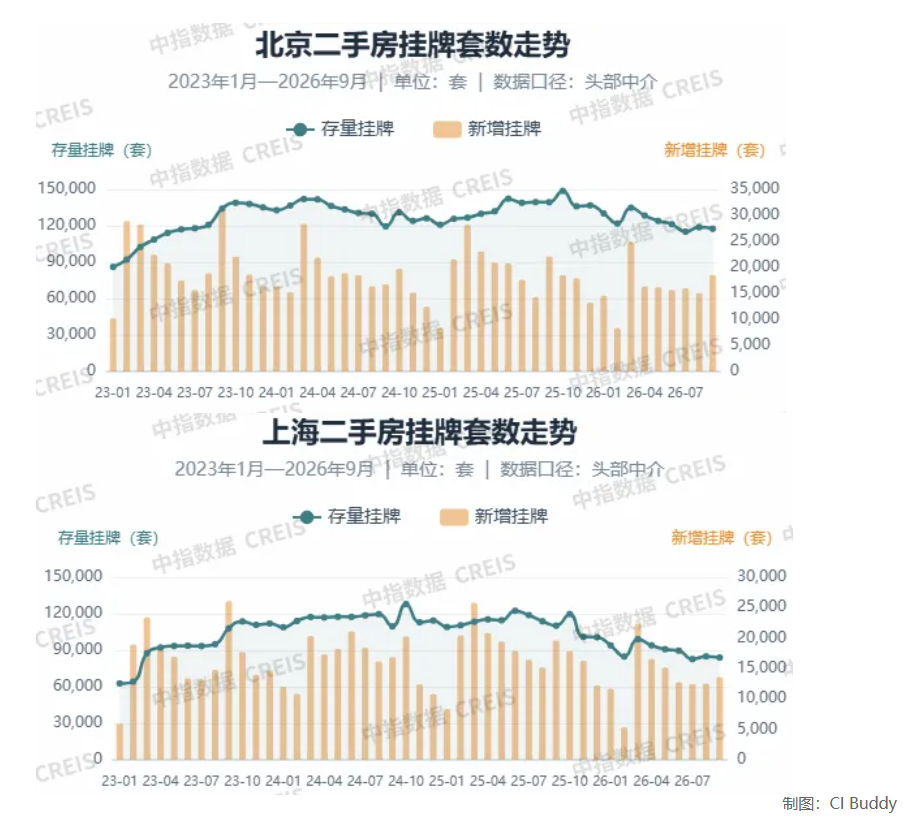
The transaction volume of second-hand houses has rebounded, the number of superimposed listings has dropped, and the bargaining space has also narrowed simultaneously.According to data from leading intermediaries monitored by China Index, the bargaining space for second-hand housing in Beijing and Shanghai has been generally stable since this year. In September, the bargaining space in Beijing was 6.99% and in Shanghai was 6.42%, both of which were significantly lower than the highs in September last year.
Taken together, in the first three quarters of 2026, the activity of the second-hand housing market in Beijing and Shanghai will remain high, rigid demand will still be the basic volume of transactions, improving demand will recover marginally, and market supply pressure will ease.
Looking forward to the fourth quarter, the implementation of the interest discount policy for residential home purchase loans is expected to provide certain support for the demand for eligible first-time homes. It is expected that second-hand housing transactions in Beijing and Shanghai will still be active to a certain extent.Overall, the current market recovery is still mainly driven by rigid demand. The key to price stabilization lies in the continued release of improving demand, whether the scale of listings can remain stable, and the further recovery of residents' expectations.(Cao Jingjing, General Manager of Index Research Department of China Index Research Institute)
Editor in charge: Li Xia