CCTV News (Reporter/Wang Jingyuan, Manuscript/Lu Yang): Education will prosper, the country will prosper, and education will be strong. On the eve of the 2025 National People's Congress and the Chinese People's Political Consultative Conference, in the "I Have Questions Ask Representatives" street procurement activity carried out by CCTV.com, a person who has been engaged in the education industry for 15 years expressed his voice: "I hope to return more time to junior and senior high school students through reasonable arrangements, so that they can discover what they like, so that our education can cultivate more brave, optimistic, pioneering and innovative children." Recently, Li Hongbin, a member of the National People's Congress, vice principal of Nanjing Foreign Language School, and a senior physics teacher, also accepted an interview with CCTV.com reporters on this topic.
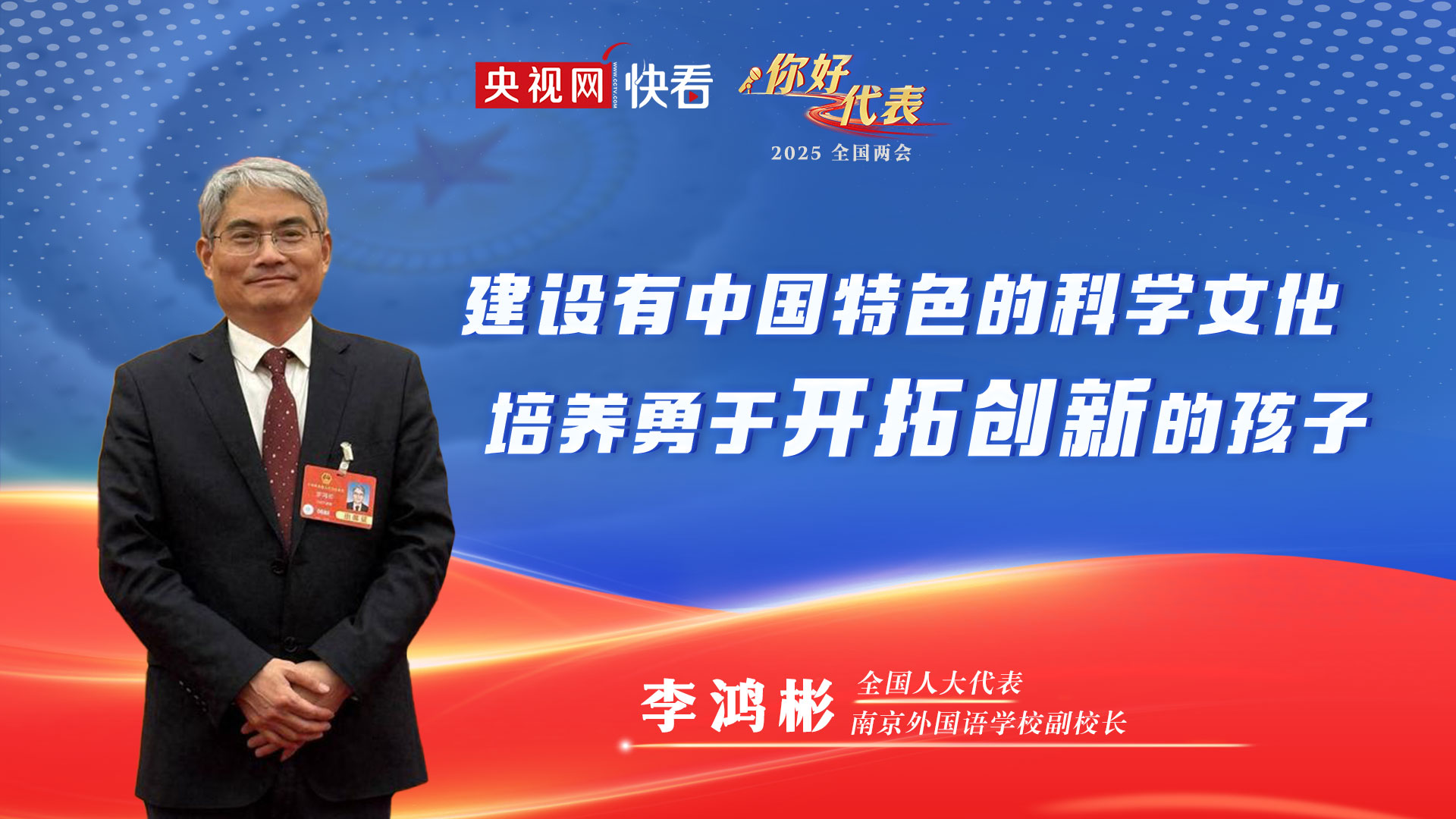
As a physics teacher with more than 30 years of teaching experience, Li Hongbin noticed many excessive educational burdens in his teaching practice. "The children's extracurricular time is arranged too much, and the children rely entirely on teachers to learn, which is not helpful to the children's growth." In Li Hongbin's view, mechanical training-style homework methods are not advisable. We should look at the potential of children more in the long run. "What they are interested in and what they are particularly focused on, we should let children achieve the best development on the track they like."
At this year's National People's Congress and the Chinese People's Political Consultative Conference, representative Li Hongbin also proposed to promote the cultivation of the scientific spirit with greater efforts and emphasize the importance of "scientific education". "The scientific spirit is a spirit that advocates rationality. It is a scientific way of thinking that we use empirical and logical deduction to verify when exploring the true nature of things."
" According to the internationally accepted measurement plan, the proportion of Chinese citizens with scientific literacy will be 14.14% in 2023. Although this data has been significantly improved compared with ten years ago, it is still far from the level of 20%-30% in developed countries." Li Hongbin pointed out that this indicator can evaluate the basic thinking ability, scientific knowledge literacy level, and logical reasoning ability of Chinese citizens to judge the authenticity of information. The "Outline of the National Scientific Literacy Action Plan (2021-2035)" (hereinafter referred to as the "Outline") issued in 2021 proposes that the proportion of Chinese citizens with scientific literacy in 2025 will exceed 15%, and by 2035 this proportion will reach 25%. The Outline puts forward requirements for gradually improving citizens' scientific literacy and national soft power development.
In Li Hongbin's view, the rapid development of artificial intelligence technology has also put forward higher requirements for citizens' scientific literacy: whether it is possible to identify the authenticity of content generated using AI, whether it is possible to scientifically view network sentiment and sort out event logic... "At present, 130 million rural residents and the elderly in my country have problems such as lack of digital literacy and relatively weak scientific resources." Li Hongbin pointed out that this group of people is easily affected by false information. He proposed that through the "small hand holding big hand" action, we can first carry out systematic and complete scientific education for students in schools, and then allow nearly 300 million students who have received systematic and complete scientific education to complete "digital feedback", which will drive the improvement of the overall scientific literacy of families.