Xinhua News Agency, Hanoi, April 12 "Can you help me make a call?" In an apartment in Hanoi, the capital of Vietnam, Chen Mingyue, 82, handed a piece of paper with a cell phone number to the reporter. After the phone was connected, opposite was Lu Meinian, a Chinese old man in Guilin, Guangxi. The two old ladies excitedly started talking in Vietnamese.
This cross-border phone call connects friendship that spans a hundred years.
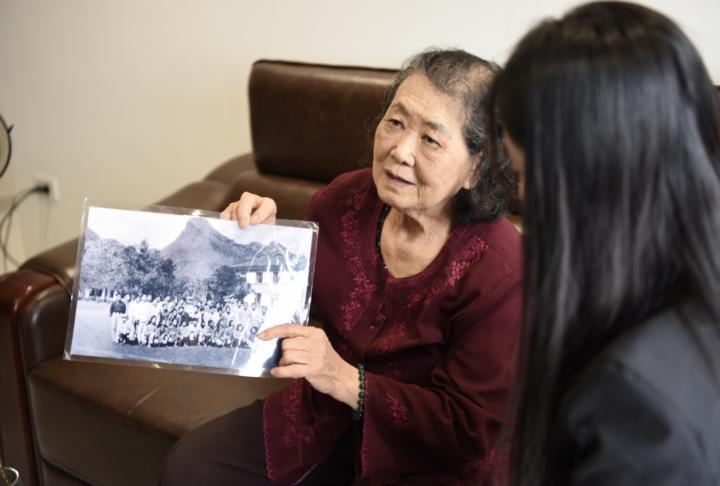
During the interview, Chen Mingyue showed reporters a group photo of her when she was a teenager at Guilin Yucai School. Photo by Xinhua News Agency reporter Su Liang
In 1953, Chen Mingyue crossed the Sino-Vietnam border to Pingxiang, Guangxi. A few years later, she went to Guilin Yucai School and became friends with Lu Meinian, who helped as a translator at the school. Now, Lu Meinian is 79 years old. On the phone, the two old men made an appointment and reunited in Hanoi after a while.
The place where Chen Mingyue crossed the border back then is now called the Friendship Pass Port on the Chinese side and the Friendship International Port on the Vietnam side. It is an important connecting port between China and Vietnam. Since the beginning of this year, more than 600,000 passengers entering and leaving the country through this port, an increase of 14.9% year-on-year. The long-standing friendship pass is witnessing the two-way journey of the Chinese and Vietnamese people in the new era.
Create friendship through cross-border exchanges
The friendship pass in spring is full of vitality.
The Vietnamese tourist Wang Chunyue's family took a photo under the sign saying "I miss you very much in Friendship Pass". Wang Chunyue told reporters that the family lives in Lang Son Province, which borders China in northern Vietnam, and it is very convenient to travel to China.
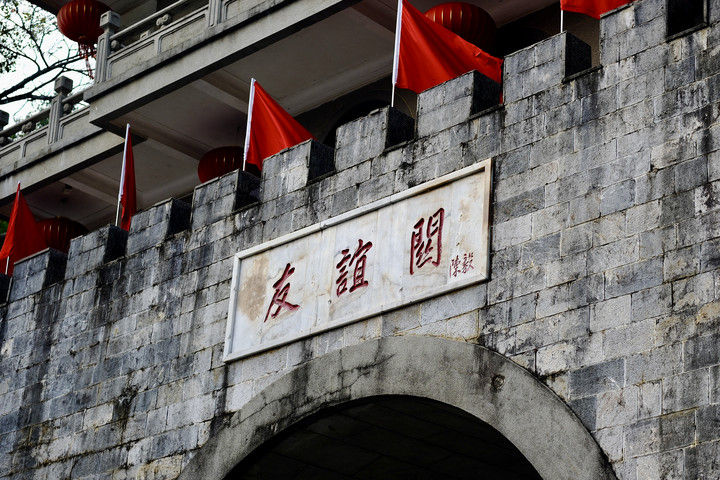
This is the Guguan Building of Friendship Passage taken on April 9. Photo by Xinhua News Agency reporter Zheng Kaijun
Vietnamese tourists who purchase snacks and seasonings from China, Chinese tourists who queue up to travel to Vietnam, and border residents who travel back and forth to do business every day... At the Friendship Pass, people cross the pass and embark on the next journey.
Friendship is not just about friendship. In the China-Vietnam Detian (Banyue) Waterfall Cross-border Tourism Cooperation Zone where "one waterfall crosses two countries", "one ticket to two countries" is becoming the latest way for tourists from both countries to check in. At the Nanxi River Port in Hekou County, Yunnan Province, hundreds of kilometers away, a large number of tourists cross the China-Julya Bridge every day. Many Vietnamese young people will go straight to the milk tea shop when they come to Hekou County. After having a good time, they will bring a few cups to Vietnam. "Drinking milk tea across countries" has become a new fashion.
In recent years, with the continuous improvement of visa and transportation convenience, more and more Vietnamese tourists have visited China, felt China and fell in love with China. More Chinese tourists also cross the border and head to Halong Bay and Phu Quoc Island in Vietnam to enjoy the unique and beautiful scenery of Vietnam.
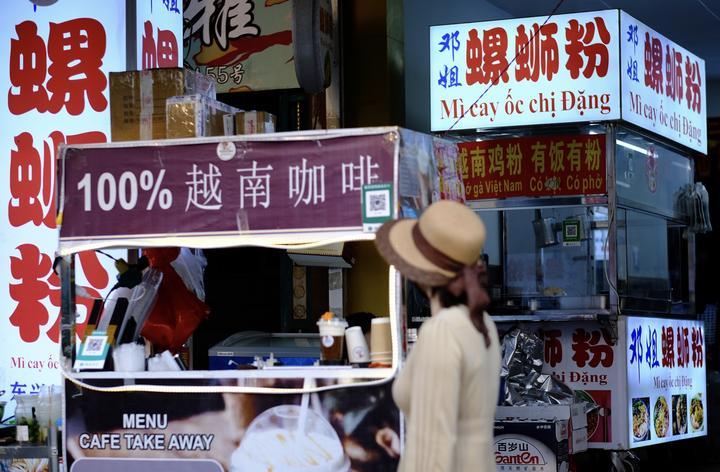
This is a street scene taken at Dongxing Port, China. Tourists from China and Vietnam taste special food and coffee here. Photo by Xinhua News Agency reporter Zheng Kaijun
Chen Mingyue told reporters that she has crossed the friendship barrier many times, traveled to China and visited friends. Nowadays, her daughter, who is a tour guide, often leads cross-border tour groups to China, and her son, who is doing business, has also gone to China to purchase goods many times. "Look, this is a Chinese product brought back by the child from Friendship Pass." She pointed to the fan at home and told reporters.
In the interview, the elderly man repeatedly mentioned that the people of Vietnam and China should interact more, enhance mutual understanding, and promote the continuous deepening of friendship between the two countries.
Old songs and new songs sing friendship
"On the running mountains, there is a cloud..." Chen Mingyue was very excited when she learned Chinese songs in Guilin when she was a child. She rolled the notebook at hand into a paper tube as a microphone and sang the Chinese folk song "Kangding Love Song".
She said that the Vietnamese students who studied at Guilin Yucai School not only learned to sing Chinese songs, but also rewrite lyrics in Vietnamese, and Chinese teachers also liked it very much.
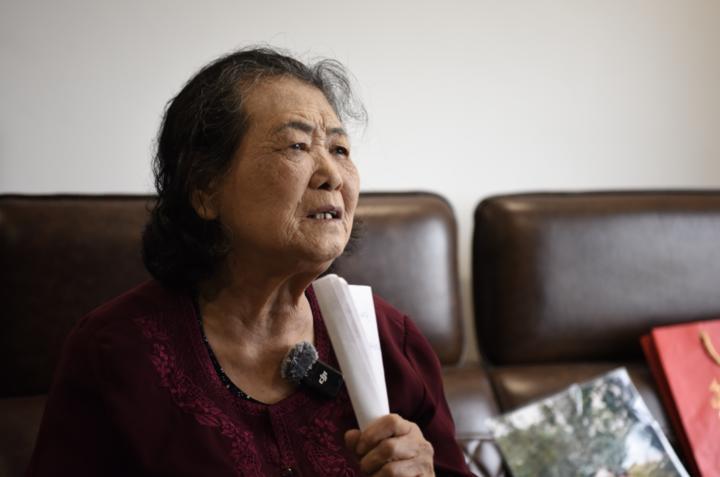
During the interview, Chen Mingyue rolled the paper into a "microphone" and sang "Kangding Love Song" to reporters. Photo by Xinhua News Agency reporter Su Liang
The study time in China is unforgettable for the elderly. "Yucai School has trained more than 10,000 students for Vietnam" - President Xi Jinping also mentioned this historical story when meeting representatives of young people and friendly people from China and Vietnam in 2023.
Time passes, and true love lasts forever. The melody of China-Vietnam friendship travels through time and space, and writes new melodies in the continuous deepening of cultural exchanges.
President Xi Jinping also mentioned in that meeting that Vietnamese pop songs were spread on Chinese social media, and Vietnamese singers gained a large number of Chinese "fans" in Chinese variety shows.
Sun Xialing, a Vietnamese singer who participated in the Chinese variety show "Ride the Wind 2024", is very touched by this. She said that she had gained valuable and unforgettable experiences and was "fortunate to contribute to promoting youth exchanges between Vietnam and China."
She remembered that once when she was performing in Nanjing, an audience was waving the Vietnamese flag in the audience to encourage her, which moved her very much. "I hope that through songs and performances, the connection between the young people of the two countries and the two countries will be closer."
The chief writer: Su Liang, Zou Xuemian, Qiao Jihong
Participated reporters: Zheng Kaijun, Ma Zheng, Li Xie, Wang Xiansi, Yang Chi, Huang Yaoteng, Lu Youyi, Hu Jiali