

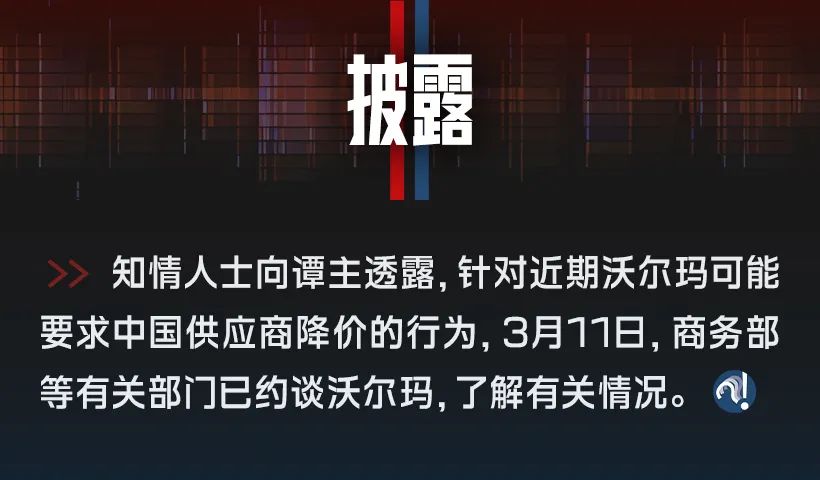
Informed people revealed to Tan Zhu that in response to Walmart's recent behavior that Walmart may require Chinese suppliers to lower prices, on March 11, the Ministry of Commerce and other relevant departments have summoned Walmart to learn about the relevant situation.

According to US media disclosures, some time ago, Walmart asked some Chinese suppliers to significantly reduce prices.
US media disclosed that Walmart's purpose in doing so was to pass on the burden of the US government's new round of tariffs on China to Chinese suppliers and Chinese consumers.
During the Trump 1.0 period, the tariffs imposed by the US government on China were mainly borne by American consumers.
In 2018, the tariffs imposed by the United States on steel, aluminum, solar panels and Chinese imported products fell entirely on American consumers and businesses, causing at least US dollars to lose at least US$1.4 billion per month.
Now, Walmart not only requires Chinese suppliers to lower prices, but also requires Chinese suppliers to do business at a loss.
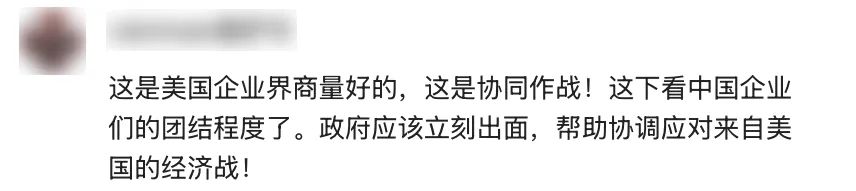
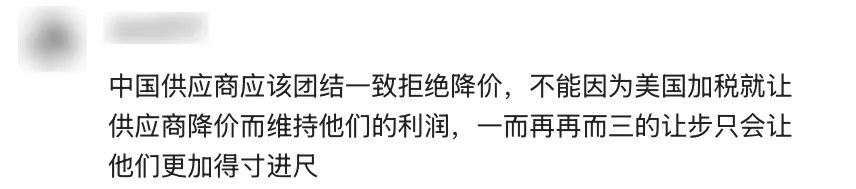
Chinese manufacturing practitioners mentioned in the comment section of relevant news that Chinese companies "have no room to reduce prices for US tariffs."
Relevant suppliers expressed dissatisfaction with this, and Chinese netizens expressed strong opposition, and many parties called on government departments to take action as soon as possible.




The Lord Tan believes that this interview sent a clear signal to Walmart.
If the situation is true, Walmart requires Chinese suppliers to bear all tariffs unreasonable, which will interfere with fair competition and foreign trade order.
Shi Xiaoli, a professor at the School of International Law of China University of Political Science and Law, told Tan Zhu that Walmart temporarily asked Chinese suppliers to reduce prices, which may violate the commercial contract. This will disrupt the normal market trading order.
The Tan Master believes that the first signal sent by this interview is that Walmart unilaterally demands that Chinese companies lower prices, which may cause the risk of supply chain breakage and harm the interests of Chinese and American companies and American consumers.
According to relevant estimates, about 60% of the products purchased by Walmart globally come from China.
Walmart and Chinese suppliers are definitely not a relationship between you "high" and I "low". On the contrary, it is precisely because most of Walmart's products themselves are produced in China that Chinese consumers can find a replacement.
Search for Walmart's homologous factories and go to OEM stores to buy Walmart's homologous products. This path is not a secret among Chinese consumers.
Capture and analyze the discussions on Walmart products on the entire platform in the past three months. Tan Zhu found that Chinese consumers favor a certain type of milk under Walmart, which is produced in a company in Guangxi.
The Tan Master sorted out the supply chain of the company and found that the company not only supplies Walmart, but also supplies many retailers and supermarkets in China - including dealers, branded milk stores, large supermarkets, etc.
Same goes for other hot-selling products in Walmart. Therefore, from the perspective of supply, Walmart's "must-buy products" favored by the public are not necessary.
It can be seen that Walmart itself cannot do without Chinese suppliers and its purchasing power.
Walmart's core competitiveness lies in its "everyday low price" (EDLP) strategy. In order to strive for low prices, Walmart requires excluding the manufacturer's sales agent from the transaction and ordering directly from the manufacturer to reduce the purchase price, which is to "direct procurement".
In recent years, many large supermarkets in China have also increasingly adopted the "direct purchasing" model. According to relevant analysis, up to 80% of the goods in Pangdonglai Supermarket stores are direct-purchased products, and Yonghui's direct-purchased ratio is about 70%.
Master Tan believes that the second signal sent by this interview is that the unilateral tariff imposed by the United States hurts Chinese and American companies, and Chinese and American companies should work together to deal with it.
The Chinese market is a pole of Walmart's global growth over the past year.
The latest data shows that in the past fiscal year, same-store sales in Walmart's Chinese market increased by 12.5%, 13.8%, 15% and 23.1% year-on-year respectively, far higher than its growth rate in the US market.
In 2025, as American consumers face multiple pressures such as inflation, high borrowing costs and credit tightening, Walmart is not favored by the US capital market.
Last month, Walmart's stock price plummeted, becoming the worst-performing constituent stock in the Dow Jones Industrial Average.
If the situation is true, Walmart's behavior is not conducive to Walmart's business development in the Chinese market.
Walmart can give full play to its positive influence in US domestic politics and overcome difficulties with Chinese suppliers. Chinese and American companies should work together to meet the tariff challenges of the US government.
Chinese and American companies are victims of tariffs. Mr. Tan believes that if the situation is true, Walmart should stop the relevant unilateral price reduction behavior and communicate with Chinese suppliers through fair, reasonable and friendly negotiations.
China and the United States have broad common interests and broad space for cooperation, and the essence of the economic and trade relations between the two countries is mutual benefit and win-win results. American companies should see this more clearly.