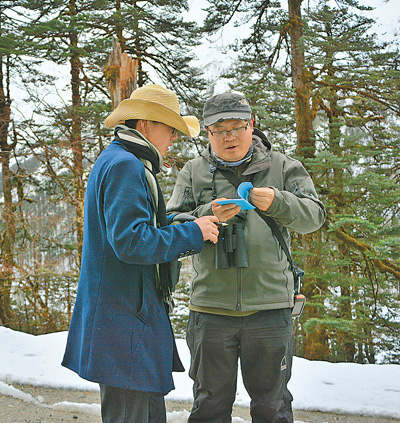
Yang Le (right) is conducting research in the field.
Photo provided by the interviewee
Walking into the Plateau Biology Institute in Lhasa, Tibet, Deputy Director Yang Le greeted the doorman in Tibetan. This Hunan man has been working here for more than 20 years. "Now, my hometown is Tibet," he said with a smile.
In 2004, Yang Le, who graduated from university, chose to become a volunteer in the Western Project, and came to Tibet from Beijing, and has since formed an indissoluble bond with him.
From volunteers to researchers
Just just came to Tibet, Yang Le was assigned to work at the Autonomous Region Health Supervision Institute. When the service was about to expire, Yang Le was a little confused: "Do I still want to stay here?" A crane chirping in the early morning helped Yang Le make up his mind.
At the end of February 2005, in Linzhou County, Lhasa, Yang Le met Cang Jue Zhuoma, an expert in the research of black-neck crane of the Tibet Plateau Biology Institute. "Are you interested in coming to our place to participate in the black-necked crane research?" Cang Jue Zhuoma sent him an invitation. Yang Le, who was a major in biology, was moved. Afterwards, he followed the research team to conduct a field observation of a black-necked crane.
Yang Le always remembered that that morning, he was awakened by a scream. When he walked out of the room, he found a group of black-necked cranes dancing in the wild. This is the first time he has seen a large number of wild populations of black-necked cranes. In the frost of the morning, Yang Le set up a telescope with his breath and witnessed the dance of more than 200 black-necked cranes.
As he deepened his understanding of this plateau, he deeply felt that there was insufficient professional talents here. "The black-necked crane needs not only observation, but also systematic protection with scientific support. In this regard, I can do a lot of work." Yang Le thought.
So, Yang Le stayed in Tibet and came to the Plateau Biology Institute to engage in the research of black-necked cranes.
Sleeping in the open air and conducting field surveys
Although I have been to many places, what impressed Yang Le the most was the crane chirping in the wilderness in Linzhou County late at night. "Linzhou County has two main black-necked crane habitats, which are not close to each other. We have limited manpower and usually only conduct fixed-point observations on one of them." Yang Le thought that if we cannot observe the two habitats at the same time, how to determine that the populations between the two places have no repeated statistics or omissions?
So, one evening, after counting the number of black-necked cranes in the first habitat, he rode his bike along the river beach to another habitat, and arrived late at night, successfully completing the observation and recording of the black-necked crane.
When returning, due to darkness and unfamiliar with the surrounding conditions, Yang Le could no longer tell the way back and could only move forward in the dark. The cold wind whistled, and he felt anxious. Suddenly, a clear crane sound came from a distance. "This is the sound of the black-necked crane. It is absolutely right to go back in this direction. This is they guiding me!"
Sleeping in the wind and dining in the open did not stop Yang Le's pace. Since 2007, Yang Le has conducted more than 10 winter surveys across the region on Tibet's black-necked cranes. The field surveys have been spread across every district and county in Tibet, with a travel of nearly 20,000 kilometers per year.
Technology has helped plateau ecological restoration
For more than twenty years, the black-necked crane has accompanied Yang Le's plateau years and witnessed the continuous improvement of observation technology.
Previously, researchers needed to stay in the field from morning to night to conduct observations. In order to fully observe the daytime behavior rhythm of the black-necked crane, while using a monocular telescope to continuously observe, observers also have to use a recorder to orally record the relevant situation, and spend more time at night to convert it into text materials. Now, with the launch of high-definition cameras and drones, observation has become more convenient.
In Quma Township, Lazi County, Tibet, Yang Le came to the side of the river. He used his mobile phone to contact the staff on the other side, and the two of them raised the drone at the same time. "We keep the speed consistent and move forward slowly." Yang Le issued an order over the phone.
Unmanned aerial vehicles on both sides take off at the same time, and observe the black-necked cranes living in the entire valley through multi-point observations, which allows researchers to record the number and distribution of black-necked cranes in the valley as a whole without worrying about omissions. "This is a recording method that was difficult to imagine before." Yang Le sighed.
The habitat located in Lazi County is his new discovery over the years. Once, Yang Le conducted a field scientific expedition here and accidentally discovered a large population of black-necked cranes here. In this small river valley, nearly 2,000 black-necked cranes that come to overwinter. Early that morning, he drove into the valley and saw hundreds of black-necked cranes scattered. As he approached, a large group of black-necked cranes took off from the shimmering water and flew towards the blue sky in the morning light.
"The number of black-necked crane populations continues to increase, marking the continuous recovery of plateau ecology, and there is also a contribution from our scientific researchers here." Yang Le said with a smile, "The cranes that roar in the valley are the most beautiful natural symphony in my heart."