2025 Continuing Education has a great transformation, saying goodbye to "correspondence courses" and "amateur" and welcome "non-productive"
The Ministry of Education issued the "Notice on Doing a Good Job in the Setting and Management of Majors and Off-campus Teaching Points in 2025", requiring the optimization of the professional setting and management of continuing education in higher education; starting from the fall of 2025, the names of "correspondence courses" and "amateur" will no longer be used by the names of "correspondence courses" and "amateur", and are collectively called "non-productive".
The Notice requires that the catalog of continuing education majors with higher education degree is based on the annual update of the "Catalogue of Undergraduate Majors in General Higher Education" and the dynamically adjusted "Catalogue of Vocational Education Majors". The catalog of supplementary majors for continuing education in higher education is no longer used for professional filing.

Universities should fully consider the school's positioning and discipline advantages, the number of students, the market demand of majors of majors, and fully demonstrate that the plans to set up new majors should be set up within the full-time education undergraduate and junior college majors of at least one class of graduates that have opened.
Encourage colleges and universities with conditions to add related majors such as artificial intelligence
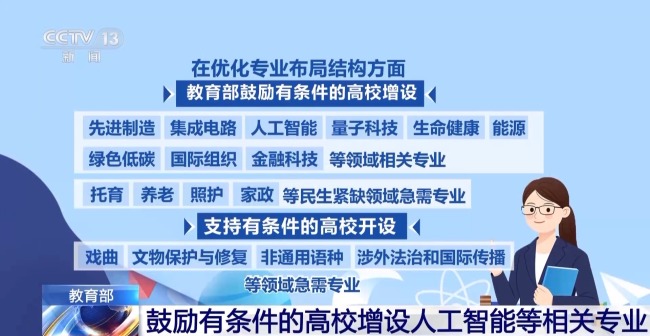
In terms of optimizing the professional layout structure, the Ministry of Education encourages colleges and universities with conditions to add related majors in advanced manufacturing, integrated circuits, artificial intelligence, quantum technology, life and health, energy, green and low-carbon, international organizations, financial technology, etc., as well as urgently needed majors in areas such as childcare, elderly care, care, and housekeeping. Support universities with conditions to open majors in areas such as opera, cultural relics protection and restoration, non-common languages, foreign-related rule of law and international communication.