
The Chinese New Year is coming soon, when are you going to go home for the New Year?
On January 14, the 2025 Spring Festival travel rush was officially launched. This is the first Spring Festival travel rush after the successful application for the Spring Festival World Heritage, and it is also the Spring Festival travel rush with an 8-day Spring Festival holiday. We have once again started "the world's largest population mobility", and hundreds of millions of Chinese people will embark on the road to return home.
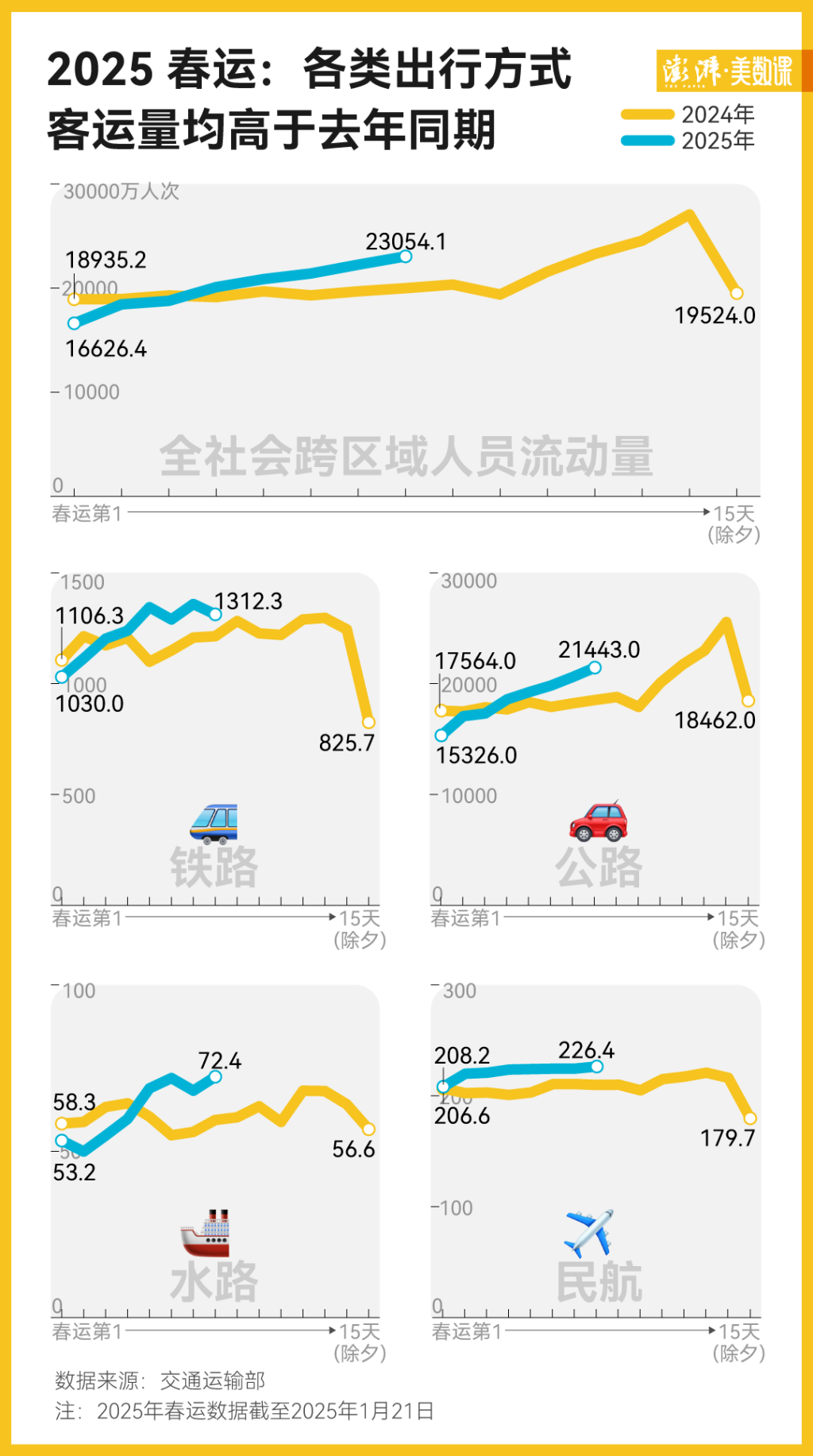
According to the daily data released by the Ministry of Transport, since the start of the Spring Festival travel rush, the flow of people traveling through railways, highways, waterways, civil aviation, etc. across the country has been rising, gradually surpassing last year.
On January 21, 2025 (the 8th day of the Spring Festival travel rush), the cross-regional flow of people in the whole society has reached 230.541 million, an increase of 15.26% over the same period last year (the 8th day of the Spring Festival travel rush rush).
Railway 12306 big data forecast shows that passenger flow before the holiday will reach its peak on January 25 (the 12th day of the Spring Festival travel rush).
The transportation department predicts that the cross-regional flow of people in the Spring Festival travel 2025 will reach 9 billion people, and the passenger volume of railway and civil aviation is expected to exceed 510 million people and 90 million people respectively, setting a new historical record.
Behind this is our huge population mobility pattern. Data from the Seventh National Census of 2020 (hereinafter referred to as the Seven Census) show that my country's migrant population has reached 376 million, 16 times that of 1990.
According to the calculations of Duan Chengrong, professor at Renmin University of China, our participation in population mobility also climbed to 26.6% in 2020, and China is transforming from a "rural China" that rarely migrates to a "migrating power" with large-scale and high-frequency migration.
Flowing China: Where do people come from and where do they go?
On the one hand, more and more people choose to go to economically developed areas; on the other hand, people are more inclined to move in the province or nearby areas.
Twenty years ago, 38.9% of people in our country were moving across provinces. By 2020, the proportion of mobility in the province has increased slightly, accounting for about 66.8% of the overall migrant population. This means that 1 out of every 3 migrant population lives outside the province.
With the transfer of industries in the east, the development of the western region and the development of new urbanization, the development between the eastern and western regions of my country has become more balanced, allowing more people to stay in their hometowns to work.
In cross-provincial migration, Guangdong and Zhejiang absorb the largest number of foreigners, and Shanghai and Beijing account for the highest proportion of foreigners. These four provinces are like powerful magnetic fields, attracting many people from neighboring provinces to influx.
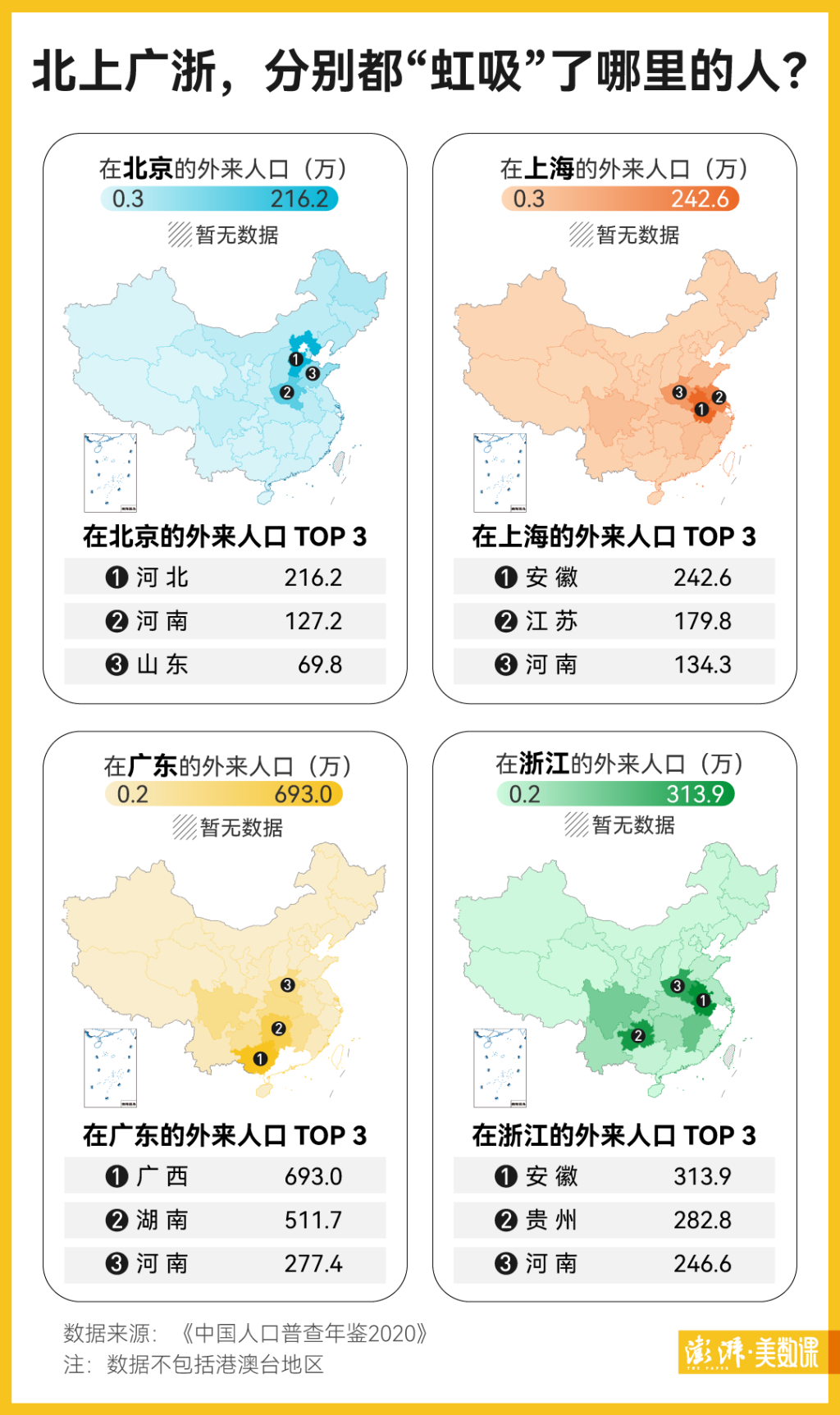
Qipu data shows that Guangdong ranks first in the country with 29.622 million cross-provincial migrant population, accounting for 23.5% of Guangdong's total population, which is more than Jilin Province's permanent population in 2023. Shenzhen, Guangzhou and Dongguan have become the places with the largest foreign population in Guangdong Province, with the three cities accounting for a total of 65.35%.
"Southeast, northwest, north and middle, we made a fortune to Guangdong." As the country's largest province of migrant population, largest economy and largest industrial province, Guangdong not only attracts migrant population in the east and west of Guangdong, but also is widely favored by neighboring provinces such as Guangxi and Hunan. Among them, in 2020, 6.93 million people came to Guangdong from Guangxi, accounting for 85.5% of the migrant population outside Guangxi.
In 2022, the proportion of working people aged 15-64 in Guangdong Province was 72%, while the proportion of elderly people was only 10%. Lu Jingliang, deputy director of the Institute of Economics and Social Sciences of Jinan University, mentioned in an interview with the media that Guangdong's migrant population is mainly young people, and the main purpose is to find employment.
However, while the Pearl River Delta region has a large net population inflow, the eastern and northern Guangdong regions are facing a net population outflow. In 2022, among the 21 cities at or above the prefecture level in Guangdong, 13 cities had net population outflows.
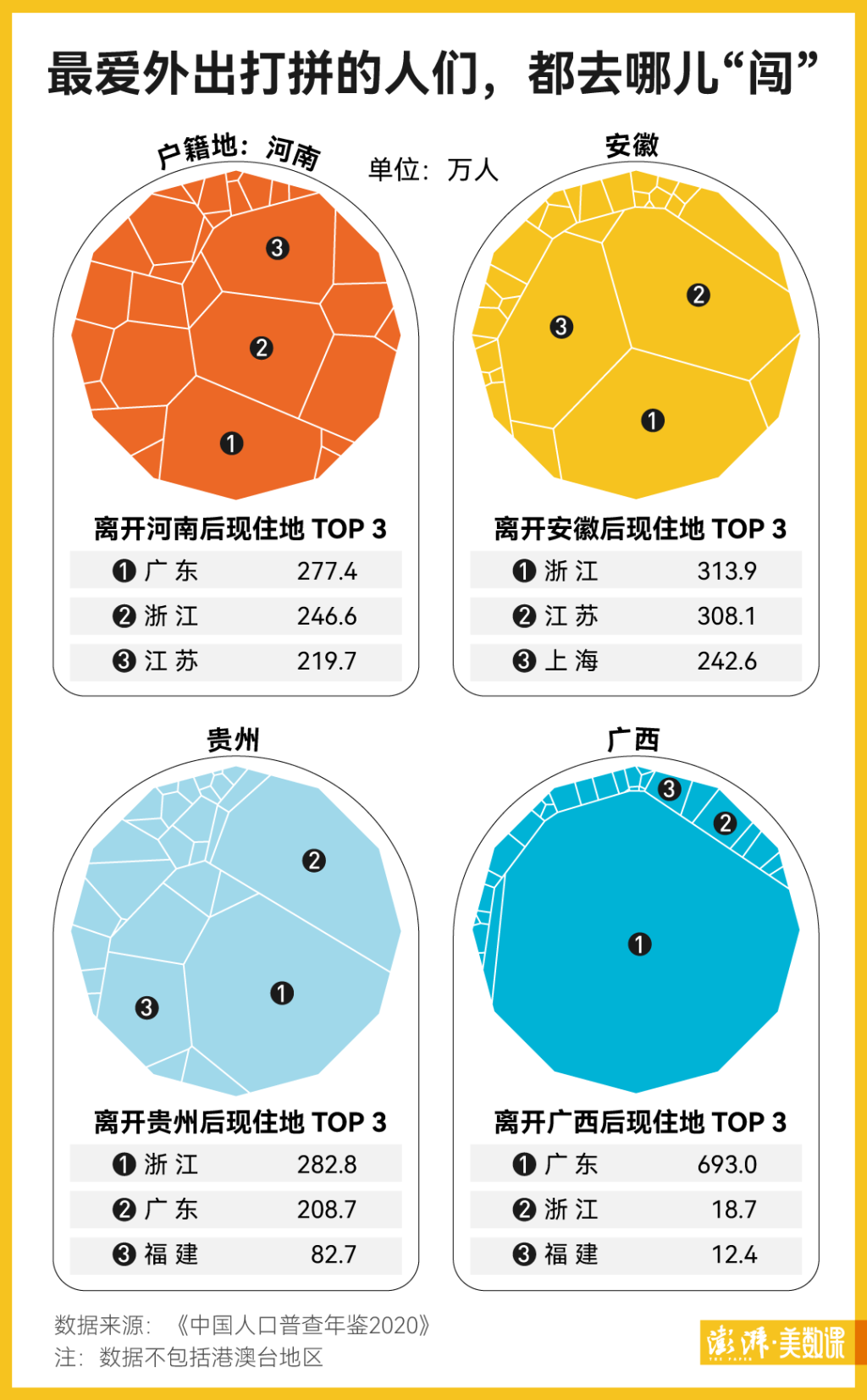
According to Qipu data statistics, compared with 2010, Zhejiang's population increase was only lower than Guangdong, ranking second.
Except Anhui, among the foreign population in Zhejiang, Guizhou, which is two provinces apart, has the largest number of people, with 2.828 million. Similarly, Guizhou people who left Guizhou also like to run to Zhejiang more.
As early as 1996, Zhejiang and Guizhou formed a "mountain and sea relationship", and the two places were closely linked. From 2018 to 2020, Qiandongnan Prefecture has achieved organized export of poor laborers to find employment in Zhejiang with 27,600 people.
What are people living across provinces trying to do?
Behind our country's huge population mobility, people's yearning and pursuit of a better life are hidden. Qipu data shows that work or study is the main reason why most people start cross-provincial life.
Guangdong, which has the largest economic province and a large number of universities in China, has attracted countless workers and college students to go there.
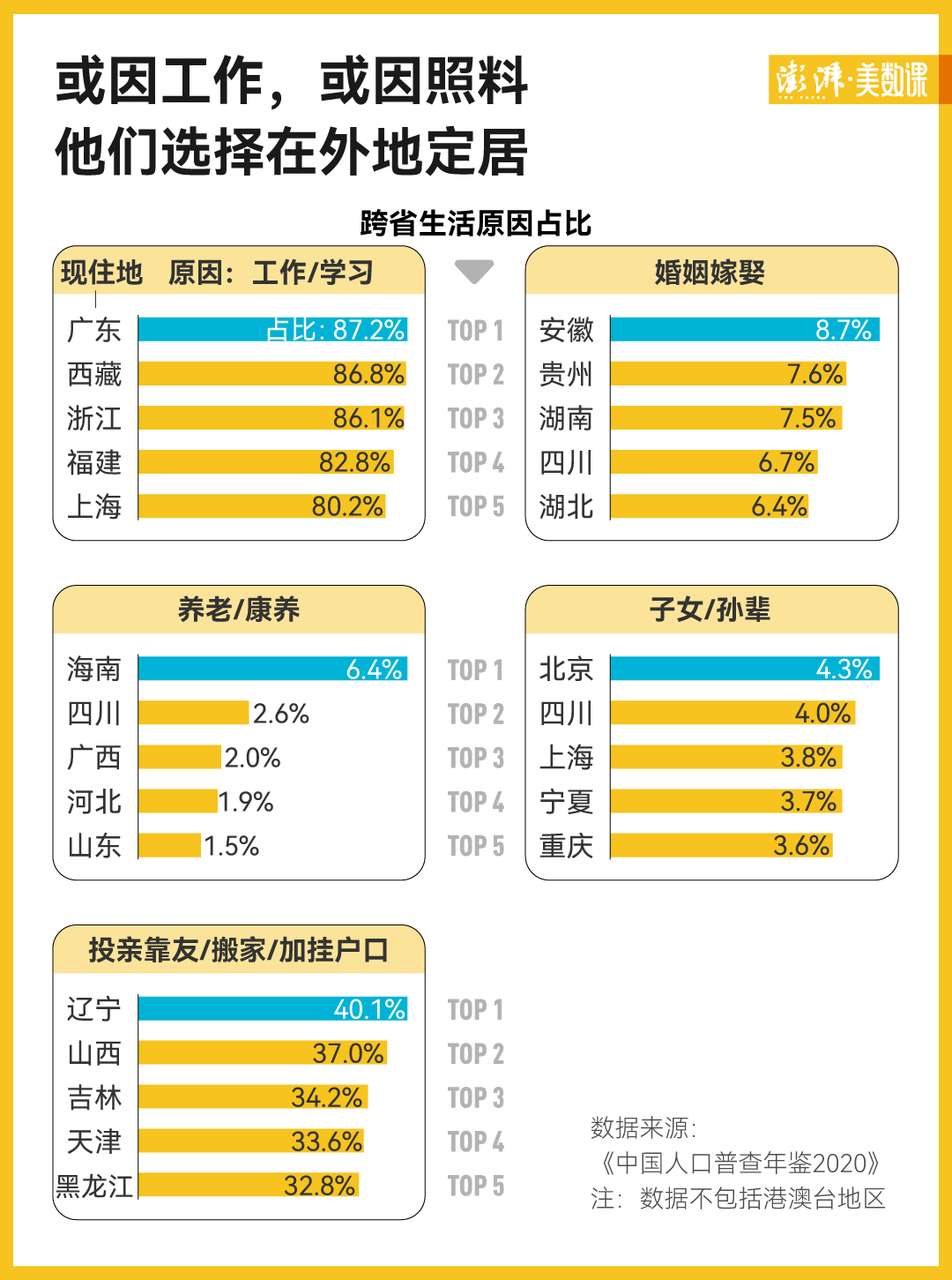
From Qipu's new reasons for taking care of grandchildren, schooling for children, and elderly care, we can see the current aging situation of China's current age structure, and it also reflects the trend of family-oriented mobility.
Many elderly people come to Beijing, Shanghai and other places where their children are located in order to take care of their grandchildren. Many elderly people also choose to travel to places with beautiful environments and pleasant climates, such as Hainan, a "oldering resort".
Work, study, marry, retirement, family... There are always so many reasons to live outside, and you will always be thinking about that family and your expectations for life.
Returning home during the Spring Festival travel rush is not only a large-scale population mobility, but also a journey of returning home full of expectations.
Source:
1. First Financial News - 376 million migrant population, experts say "high mobility" migrates to China, https://www.yicai.com/news/101047436.html
2. Southern Weekend - the secret of the largest population province growing against the trend, https://mp.weixin.qq.com/s/E4aNzZajmmI_B59Q3C9haQ
3. China.com - Combined the relationship between the mountains and seas of the east and west Together, we went to the industrial cooperation agreement, https://ex.chinadaily.com.cn/exchange/partners/82/rss/channel/cn/columns/snl9a7/stories/WS647d6f50a310dbde06d21e99.html
4. Lingnan Journal-Yang Xinhong | Research on the Current Situation and Characteristics and Trends of Population Development in Guangdong Province (Part 1), https://mp.weixin.qq.com/s/IEu0A-8RI-XRAjNxRcD10g
5. NetEase Digital Reading - China's most capable province with children does not need to give birth at all, https://mp.weixin.qq.com/s/Rm-ZMWl-lcPhi1vaf-Wobg
6. The Paper-The time is up! "Spring Festival Long Holiday" train tickets are available, https://mp.weixin.qq.com/s/TpRUwaezHOFQ8orC3eqIsw