
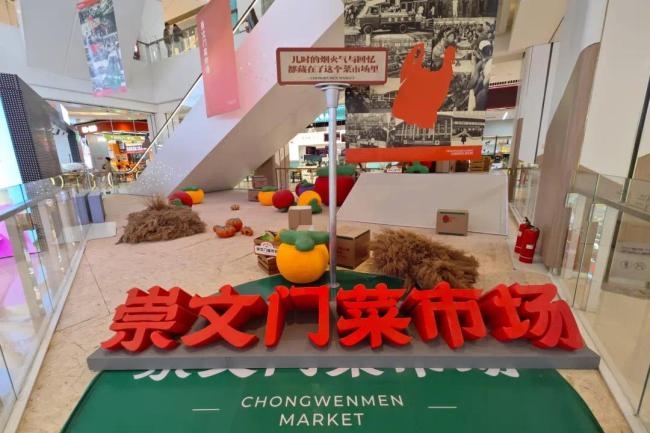
(Photo source: Beijing Daily Client)
How long has it been since you visited the vegetable market?
Whether you are a "cooking" or a "outside buying" person, you should always walk around the most popular vegetable market.
On January 8, 2025, Chongwenmen Vegetable Market returned to its original site, and nearly 100 stalls were planned, including the traditional delicacies of old Chongcai and the trendy brands that young people like. As the place with the strongest fireworks, the importance of the vegetable market affects the memory of everyone in this city.
Mr. Wang Zengqi, a Beijing-style writer, wrote in the article "Cooking", "When I arrived at a new place, some people like to visit department stores, and some people like to visit bookstores, I would rather go to the vegetable market. Look at raw chickens and ducks, fresh and watery melons and vegetables, and red peppers, which are lively and crowded, making people feel a sense of life."
Folk customs in the vegetable market
The vegetable market in Beijing starts in the morning market and is called "Xiaoshi" in Beijing dialect. Because old Beijing is used to getting up early, it usually opens at three or four o'clock in the morning, and the market is dispersed at sunrise, and it is only nine o'clock in the morning at winter. The old saying goes, "The sun rises and closes at one o'clock." Beijing Evening News reporter Liu Yida once wrote, "Xiaoshi is usually next to the city or the Tangen. For example, Dongxiaoshi outside Chongwen Gate, not far from the Temple of Heaven; Xiaoshi outside Desheng Gate is very close to the city gate tower."
The morning market closest to the "Imperial City Gate" today is the Xinmin Vegetable Market on the North Second Ring Road. It is said that during the weekend of Xinmin Vegetable Market, there were more people than temple fairs. In the words of netizens, "No one can leave the morning market empty-handed! No one!"
Through many street names in Beijing, you can also get a glimpse of the commercial map in Beijing's history.
The famous flower market street outside Chongwenmen has historically been a market dedicated to selling flowers. This category of places named after specialized markets include Gangwa City, Meishi Street, Mishi Street, Caishikou and Dengshikou. The "Lishi Hutong" in Xicheng District was historically a market that sells mules and donkeys, and evolved from "Dushi Hutong" to "Lishi Hutong". The "Pica Hutong" on the Financial Street is a well-known market for chipping in history. Compared with the "Pica Hutong", many old Beijingers are used to calling it "Pica Hutong". However, the Jinyu Hutong in Dongcheng District is not a market for selling gold and silver jewelry. According to legend, in the Ming Dynasty, there were mostly shops for buying and selling gold and silver jewelry, so everyone called it "Jinyin" Hutong. Later, due to rumors and sound changes, it was gradually called "Goldfish Hutong". Now, this is the famous Jinbao Street, which netizens call it "the most expensive street in the capital."