The annual reports of 51 REITs in Shanghai and Shenzhen stock markets have been disclosed, with a total revenue of approximately 13.3 billion yuan.
Specifically, the 33 REITs in the Shanghai Stock Exchange achieved a total revenue of 8.5 billion yuan, an increase of 35% year-on-year, with a total distributable amount of 6.2 billion yuan; the 18 REITs in the Shenzhen Stock Exchange achieved a total revenue of about 4.808 billion yuan last year, a net profit of about 136 million yuan, and a total distributable amount of about 2.406 billion yuan.
However, the operation of different underlying assets varies. Among them, new asset types such as energy assets ranked high in net profit, consumption, water conservancy, etc. performed relatively well last year; the occupancy rate of rental housing, warehousing and logistics projects intensified; while the operation of industrial parks and toll road projects fluctuates.
A public funder told the First Financial reporter that after the public fund REITs market entered a normal issuance, the market entered a new stage in scale expansion and asset diversification. The performance differentiation between new forces such as consumption and rental housing and traditional infrastructure not only reflects the pain of economic structure transformation, but also reveals the new direction of capital allocation. In the future, the deepening of policy support and market-oriented mechanisms may further activate the potential of this trillion-level market.
Energy is more profitable, and new asset types such as consumption and water conservancy have attracted attention.
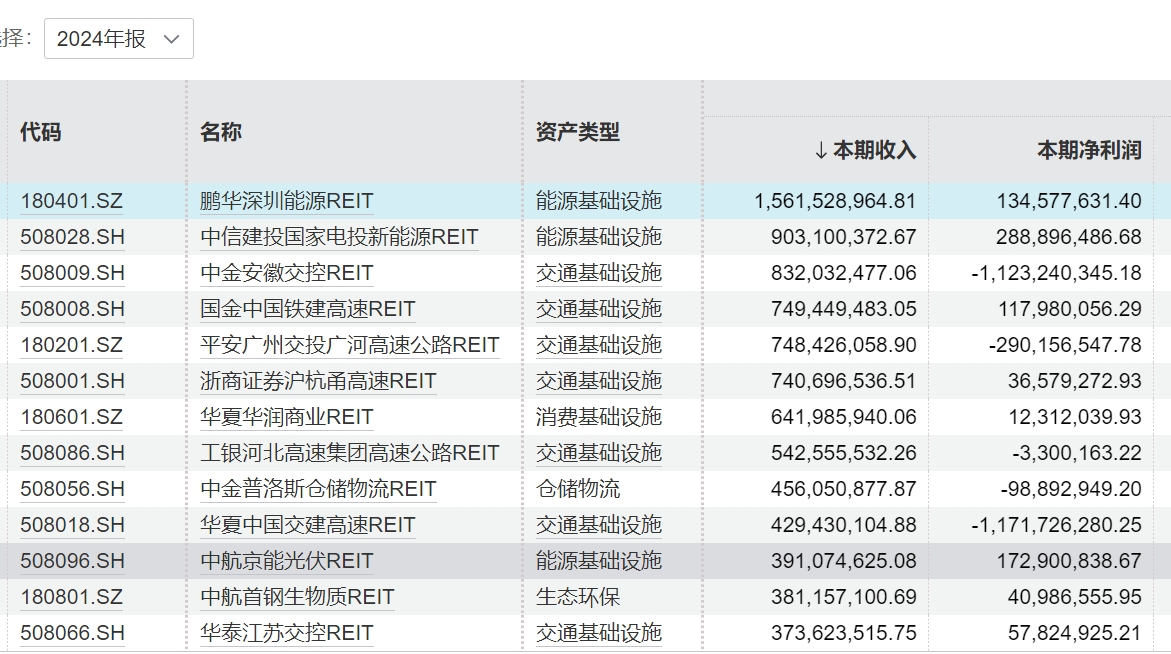
According to Wind statistics, the reporter has the highest net profit is CITIC Construction Investment State Power Investment New Energy REIT, which recorded revenue of 903 million yuan and net profit of 289 million yuan in 2024.
At the same time, the top three REITs in the market are all energy infrastructure, with a total net profit of 634 million yuan. However, there was also a counter-trend loss. As of the end of 2024, Jiashishi China Power Construction Clean Energy REIT revenue was approximately 78.69 million yuan and a net profit loss of 480.37 billion yuan.
Data source: Wind
In addition, consumer infrastructure and water conservancy facilities performed better as asset projects newly included in REITs in 2024.
The first water conservancy project, Yinhua Shaoxing Yuanshui Water Conservancy REIT, achieved revenue of approximately RMB 537.16 billion and net profit of RMB 17.206 million in 2024.
Consumer assets benefited from the recovery of offline passenger flow, with an average occupancy rate of over 95% at the end of the period. According to Wind statistics, among the 7 consumer REITs, 6 products have positive revenue and net profits, and 5 have revenues of over 100 million yuan. Among them, China Resources Commercial REIT ranked first with revenue of 642 million yuan and net profit of 12.312 million yuan. However, Huaxia Joy City Commercial REIT's revenue during the reporting period was 106 million yuan, but its net profit was a loss of 473,000 yuan. Among them, Huaxia First Outlet REIT's secondary market rose by about 39% this year.
In addition, the operation of guaranteed housing projects is stable. The average occupancy rate of REITs in the six rental housing units in the entire market reached 95%, and the rent collection rate exceeded 93%. Guotai Junan Urban Investment Kuanting Bao Rental Housing REIT ranked first with revenue of 180 million yuan, with an available distribution amount of 130 million yuan.
According to statistics from the Shanghai Stock Exchange, the total revenue of the four REITs in the Shanghai Stock Exchange achieved 410 million yuan, with a completion rate of more than 100%. In terms of operating indicators, the occupancy rate of underlying rental housing assets reached 95% on average, the rent collection rate exceeded 93% on average, and the unit rent price also maintained at a relatively stable and good level.
The differentiation of profit and loss of traditional assets: the performance of some highways and industrial parks is under pressure
The losses in net profit are mainly concentrated in transportation infrastructure REITs and park infrastructure REITs.
Among the 12 REITs in the industrial park, 5 products had negative net profits, and 5 REITs had more than 10 million net profits.
A person from Shanghai brokerage told reporters that some industrial park projects are subject to rent fluctuations and vacancy pressure, and some projects improve their occupancy rates through operational optimization and improvement, and the industry has differentiated and structural opportunities.
In addition, the losses of the two transportation infrastructure REITs exceeded 1 billion yuan. Specifically, the largest net profit loss is China China Communications Construction Expressway REIT, which has the largest net profit loss of 1.171 billion yuan as of the end of 2024. Revenue during the reporting period was 429 million yuan.
The second is CICC Anhui Communications Control REIT, which has a net profit loss of 1.123 billion yuan as of the end of 2024. Revenue during the reporting period was 832 million yuan.
"As some sections of the road during the reporting period were affected by fluctuations in traffic flow and toll revenue, the performance of REITs in transportation infrastructure was under certain pressure to a certain extent." The above-mentioned securities firm person told reporters that from the perspective of the underlying asset type, the vast majority of publicly offered REITs in transportation infrastructure are highway assets, and the overall development of the highway industry is relatively stable. There is no asset participation in the fields of railways, airports, ports, etc., and the diversification of underlying assets still needs to be made.
Risi Research Institute analyzed that the expressway industry has entered the end of the mature period, and the profit pressure of new sections and modified and expanded sections is relatively high; at the same time, the cost has increased year by year, from 70 million per kilometer per kilometer in 2013 to 130 million in 2020, and the single-kilometer construction cost of some expressways even reached more than 1 billion. Transportation infrastructure is developing towards three-dimensional and comprehensive transportation, but the investment volume is limited; the intelligence and greenness of transportation in the future require greater investment opportunities to achieve a trend reversal.