CCTV News: Recently, Beijing University of Aeronautics and Astronautics, together with a scientific research team composed of the Institute of Deep Sea of the Chinese Academy of Sciences, Zhejiang University and other units, released the latest achievements of the deep-sea small deep-sea robot. This small deep-sea robot was tested in deep-sea environments such as high-pressure and low-temperature Mariana Trench, and achieved motion performance comparable to or even surpassing laboratory room temperature and pressure.
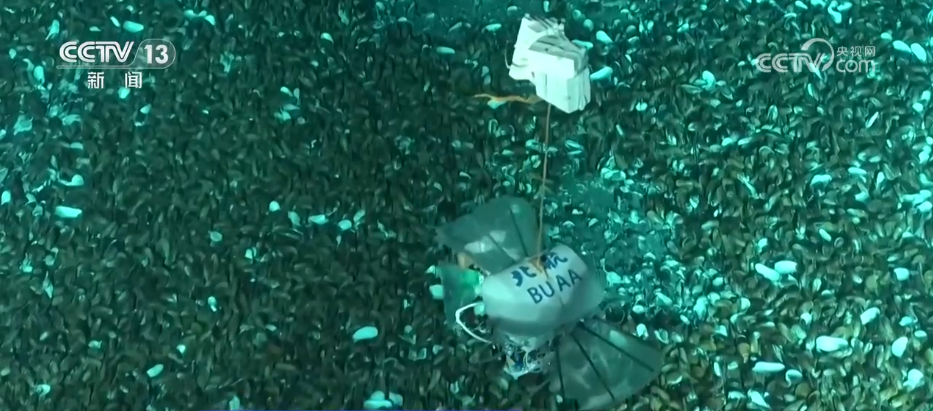
This is a shot of a deep-sea small robot testing in the Haima Cold Spring in the South China Sea with a water depth of 1,384 meters. During the test, the subjects such as swimming, gliding, deformation and crawling of the deep-sea small robot were successfully completed. Previously, the team had conducted many deep-sea tests on the deep-sea small robot, reaching the deepest of 10,666 meters deep seabed of the Mariana Trench. Thanks to the newly designed flexible deep-sea driving device, even the seabed of tens of thousands of meters, the deep-sea small robot can still smoothly switch various motion states.

Experts introduced that this deep-sea small robot is less than 50 cm long and weighs only 1.5 kilograms. The 10,000-meter deep-sea pressure is equivalent to pressing a small iceberg for it, which poses a major test for the driving components, the key component of the deep-sea small robot.

Through unique design, the robot can achieve higher driving speeds and amplitudes in the deep sea. During the six-year development process, the team members also solved many problems such as motion mode, automatic control, and overall structural design in the deep-sea environment, and completed the development of the prototype of a small deep-sea robot. At present, the team is working towards the research direction of "deep-sea flexible robot + AI" to provide a broader space for deep-sea intelligent operations.