
On the afternoon of February 25, the Dongguan Municipal Government of Guangdong Province held a press conference to release the archaeological excavation results of the Nanhai Fence Wall ruins and the construction plan for the Nanhai Fence Wall archaeological site.
In October 2023, Dongguan discovered the remains and relics of the Nanhai Cang City Wall and ancient buildings in the city during the Hongwu period of the Ming Dynasty during the cultural relics and archaeological investigation and exploration of the project land. From May to December 2024, the Guangdong Institute of Cultural Relics and Archaeology excavated this site with an excavation area of 3,000 square meters, making it the largest single archaeological excavation project in Guangdong Province in recent years.
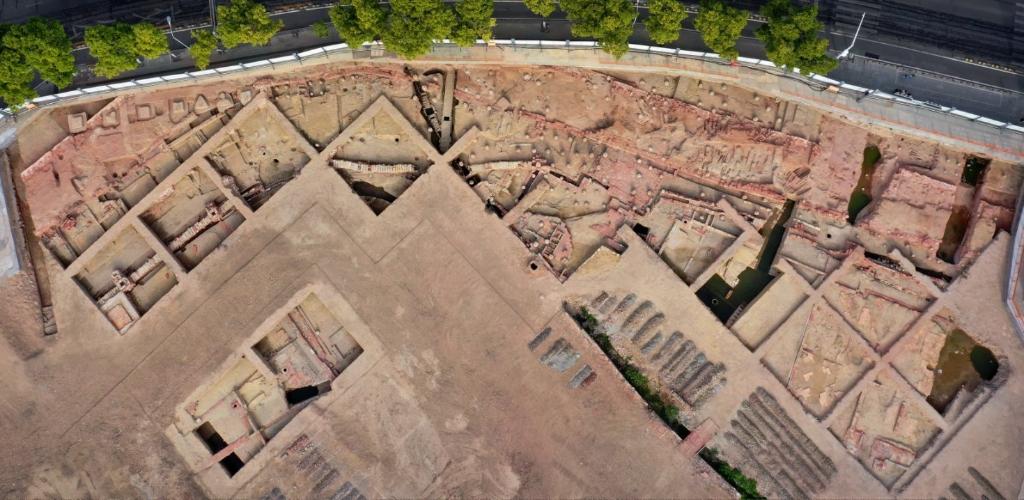
Panoramic view of the excavation of the Nanhai Acropolis Wall site. (Photo provided by Dongguan Municipal Bureau of Culture, Radio, Film, Tourism and Sports) Cao Jin, director of the Guangdong Provincial Institute of Cultural Relics and Archaeology, introduced that the Nanhaiwei City Wall ruins have rich cultural relics, and the existing accumulation period lasted from the Song Dynasty to the Republic of China. The base of the city wall and its supporting roads, drainage channels and other facilities were unearthed during the Ming and Qing Dynasties. At the same time, important relics such as building foundation groups and domestic water wells were found in the city. A large number of building components and living objects were unearthed from the site, totaling 360 small pieces and 90 boxes of fragments of various utensils.
The most important discovery is the "No. 1 City Wall Foundation" discovered in the west and north of the site. The excavated parts are the northern section of the West City Wall and the western section of the North City Wall. The overall preservation of the city wall is good, the plane is curved and the cleaning length is about 100 meters. The wall is about 7.6 meters wide, and the inner and outer sides are covered with red sandstone strips of stone, with rammed earth intertwined in the middle. The residual rammed earth is about 2 meters high and the layer thickness is 0.08 meters to 0.12 meters. There are many shells or broken bricks and tile layers between the rammed earth layer. Based on the stratigraphic relationship, building materials and documentary records, it is comprehensively judged that this section of the city wall should be the Nanhai Cang Wall of the Ming Dynasty.
As the core acropolis in the three-level defense system of Guangdong's coastal defense system in the Ming Dynasty, the Nanhai Guard undertakes the dual functions of the military command center and the coastal defense outpost in the Guangdong Central Coastal Defense System. Cao Jin said that the excavation of the Nanhaiwei site has important historical and cultural and academic value. The site confirms the important position of Dongguan as the "first gateway to the Guangdong Sea" in Guangdong's military coastal defense system in the Ming Dynasty, revealing the spatial pattern and construction regulations of the coastal defense city in the Ming Dynasty. It is an important achievement of the archaeological research of coastal defense in the Ming Dynasty and Qing Dynasty, and is of great significance for the study of coastal defense history, architectural history, social history, etc.
Chen Zhijun, deputy secretary-general of Dongguan Municipal Government, said that in the next step, Dongguan will take effective protection measures to plan and build the archaeological park of the Nanhai Cang Wall ruins, and strive to promote the protection, inheritance and revitalization of cultural heritage. (Reporters Huang Haoyuan and Xiong Jiayi)