
For the first time in the world! The research team of Fudan University discovered a new therapeutic target for Parkinson's disease
Recently, the Yujintai team of Huashan Hospital affiliated to Fudan University has achieved major scientific research breakthroughs through five years of clinical and basic research, and discovered the new therapeutic target for Parkinson's disease for the first time in the world. The new therapeutic targets and candidate drugs found in this study are expected to intervene in Parkinson's disease from the early stages of the disease and delay disease progression. Related research results were published online in the international academic journal Science (Science) on February 21, Beijing time.
The number of patients continues to rise. Parkinson's disease has become a world problem.
Parkinson's disease is the second most common neurodegenerative disease after Alzheimer's disease, which seriously affects patients' daily life. The global number of Parkinson's disease patients is expected to increase from about 7 million in 2015 to 13 million in 2040, and the total number of Parkinson's disease patients in my country accounts for about half of the world. Traditional drugs and surgical treatments are only used to treat symptoms of Parkinson's disease and cannot delay the progress of the disease. Therefore, further research on the deep causes of Parkinson's disease and carry out targeted treatments, becoming a strategic highland that scientists in relevant fields around the world compete to explore.
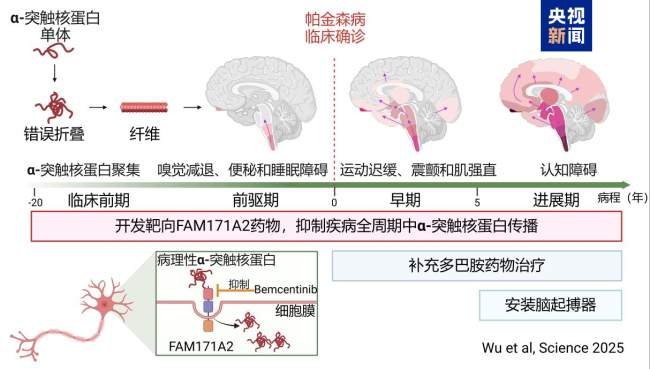
△Parkinson's disease course progress mechanism and intervention methods
Fam171A2 target was the key to pathological α-synuclein transmission
The Yujintai team at Huashan Hospital Affiliated to Fudan University has clarified the "fuse" of the transmission of pathological α-synuclein between neurons through five years of careful research, and discovered new drugs that inhibit its transmission process, providing new ideas for the treatment of Parkinson's disease.