
CCTV News: Not long ago, the Central Committee of the Communist Party of China and the State Council issued the "Opinions on Deepening the Reform and Development of Elderly Care Services", proposing to promote the classification reform of elderly care institutions and divide elderly care institutions into three categories: bottom-line guarantee type, universal support type, and complete market type. What are the differences between these three types of nursing homes, and how should we choose?
The "Opinions on Deepening the Reform and Development of Elderly Care Services" clearly states that bottom-line protection nursing homes mainly accept extremely poor elderly people and disabled elderly people in financial difficulties. Inclusive support nursing homes are open to all elderly people, and the municipal governments with prefecture-level cities formulate support measures and strengthen charging guidance and management; fully market-oriented nursing homes implement full competition, high-quality and high-price prices to meet the diversified needs of the elderly.
Li Banghua, deputy director of the Elderly Care Service Department of the Ministry of Civil Affairs, said that the classification of elderly care institutions into a bottom-line guarantee type, universal support type, and complete market type. The functional positioning and operating mechanism of the three types of elderly care service institutions will be further distinguished, and the service supply will be more accurate and the policy measures will be more accurate, so as to promote the realization of a service pattern with bottom-line guarantee, services with basic needs, services with universal support, and selective markets.
Base guarantee type: Let the elderly in extreme poverty have a care for the elderly
Among the three types of nursing homes, the basic guarantee type nursing home is mainly provided by the government according to the planning. This time, the opinions clearly state that the main targets for the elderly in extreme poverty and the disabled elderly in financial difficulties are the elderly in financial difficulties.
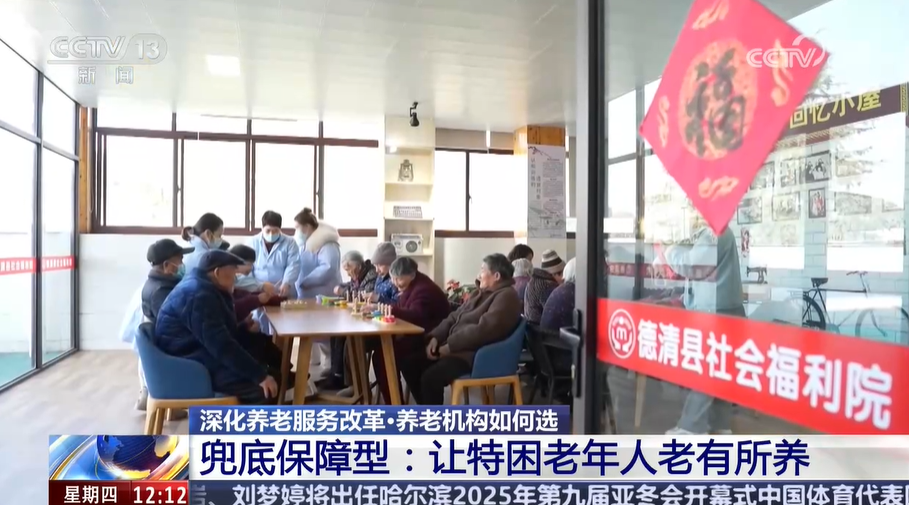
The Social Welfare Home of Deqing County, Zhejiang was used to be a universal nursing home. After being upgraded and transformed last year, it was transformed into a bottom-line nursing home, undertakes centralized support services for extremely poor elderly people in the county and stops accepting social elderly people.
Inclusive support type: Open to all the elderly
Although the bottom-line protection type nursing homes charge low fees, they are only for the elderly in special difficulties. For most elderly people, they choose universal elderly care institutions more.
In Shenzhen, relevant departments stipulate that the maximum monthly fee for general-purpose elderly care institutions is no more than 1.3 to 1.5 times the per capita disposable income of residents in the previous year. Currently, the average monthly fee for general-purpose elderly care institutions in Shenzhen is about 7,000 yuan.
Complete market-oriented: Meet the diversified elderly care needs of the elderly
Complete market-oriented elderly care institutions are mainly aimed at the elderly who pursue personalized and high-quality elderly care life and have corresponding economic strength. Meet the diversified elderly care needs of the elderly.
In Beijing, Wang Hongcheng, who is in his 80s, chose a nursing home next to the Second Ring Road. This nursing home has a superior geographical location and is very close to a Grade A hospital, but the fees are also high. The current monthly expenses are more than 10,000 yuan.
In the past, this type of nursing home with higher fees has been questioned by many people. This time, the "Opinions on Deepening the Reform and Development of Elderly Care Services" clearly states that it is necessary to fully stimulate market vitality and support all types of market entities to actively participate in elderly care services in accordance with market-oriented principles.