From January 1, 2025, the revised "National Natural Science Foundation of China" will be officially implemented. This is the first revision in 17 years since the implementation of the Regulations on April 1, 2007. What changes have been made in the newly revised regulations and what impact will they have on my country’s scientific research work? The reporter interviewed experts in related fields.
Where does the money come from?
After this revision, Article 4 of the Regulations stipulates the source of natural science funds: mainly from central budget allocations, encouraging local governments, enterprises and other organizations to invest funds in a joint funding model, and encouraging donations from social forces.
"The National Natural Science Foundation of China began to explore the joint funding model in the mid-1990s, and to this day, it has formed a mature joint funding model." Hu Ming, professor at the School of Law of South China University of Technology, said that the revision of the Regulations can fully mobilize the enthusiasm of all sectors of society to participate and invest in basic research, and can better play the platform-oriented role of the National Natural Science Foundation, and build the joint fund into an important platform to promote the transformation of basic research results and promote the integration of excellent results, promote the integrated development of scientific research and industry, the deep integration of innovation chains and industrial chains, and promote the benefits of scientific funding results to the society.
Zhang Qiang, professor of the Department of Earth System Science, Tsinghua University, said: "Social forces can support basic research through the National Natural Science Foundation of China. They can use the professional and credible evaluation mechanism of the National Natural Science Foundation of China to help select the best and most promising projects and introduce donations from social forces. They can increase funding efforts, alleviate the current low funding rate, and achieve a win-win situation."
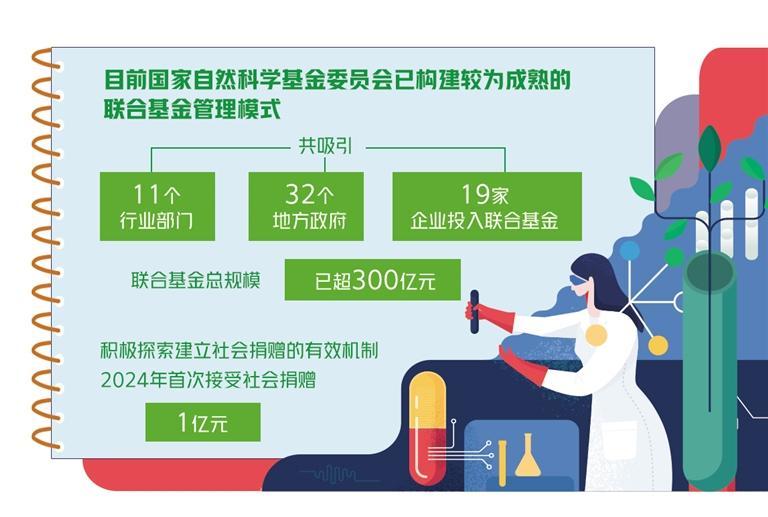
According to the reporter, the National Natural Science Foundation of China has established a relatively mature joint fund management model, attracting 11 industry departments, 32 local governments and 19 enterprises to invest in joint funds, and the total scale of the joint fund has exceeded 30 billion yuan; in addition, we actively explore the establishment of an effective mechanism for social donations, and accept 100 million yuan in social donations for the first time in 2024.
How to spend money?
The Regulations emphasize that science funds support talent training and team building, and in Article 8 it is clear that special funds should be established to support young talents.
Zhang Qiang said: "Young scientific and technological talents are the main force in the development of science and technology innovation in my country. At present, the Foundation has established a relatively complete youth talent funding system composed of youth funds, excellent youth and outstanding youth projects. In the past two years, special pilot work has been carried out for undergraduate and doctoral students. The revision of the Regulations clearly states that the fund should establish special funds for cultivating young scientific and technological talents. While clarifying past successful practices in the form of regulations, it also shows young scholars the determination of the National Natural Science Foundation of China to unswervingly support outstanding young talents. We have reason to look forward to that in the future, the Foundation will further increase the funding for young scientific and technological talents and promote the development of education and scientific and technological talents in an integrated manner."
In order to encourage original basic research, Article 17 of the Regulations clearly states that fund management institutions can formulate special application and review regulations for major original, interdisciplinary innovation and other projects.
Lu Wei, a researcher at the Development Research Center of the State Council and former member of the Standing Committee of the National People's Congress, said: "This revision has given the green light to explore the selection mechanism for non-consensus original innovation projects. In future practice, various forms can be explored, such as establishing a 'non-consensus project' screening mechanism recommended by experts with real names, providing scientists with greater autonomy in selecting research directions and technical routes, and adopting staged evaluation and rolling support methods to gradually advance and cultivate original scientific research."
How should money be managed?
Articles 9, 10, 38 of the Regulations involve the dependent unit, mainly including the relaxation of the scope of registration of the dependent unit, strengthening the management responsibilities of the dependent unit, and increasing the punishment for the dependent unit's violations.
Yang Lingchun, deputy director of the Department of Science Research of Peking University, said: "This means that the dependent units will play a more important role in the fund management process. As the dependent units, fund management not only assumes the responsibilities of the scientific research management department, but also needs to further coordinate the joint cooperation of all management departments on the campus, continuously improve the scientific research project management system, and promote the standardization, process and refined management of the natural science fund work."
Hu Ming believes that the revision of the Regulations implements the requirements of the CPC Central Committee and the State Council on the reform of "deregulation, regulation and service" in the scientific research field. The "Regulations" strengthen the responsibilities of relying on the unit can improve the quality and efficiency of scientific fund management.
The Regulations have made a series of new provisions in strengthening the construction of scientific research integrity and scientific and technological ethics, including the addition of a new commitment system for scientific research integrity (Article 12 and 21), the addition of a joint punishment mechanism (Article 13, 18 and 35), strengthening the handling of violations, and the addition of new types of violations (Chapter 6).
Yang Lingchun believes that these measures are intended to improve the sense of responsibility of scientific researchers, supporting units and review experts, and create a fair, just and clean and upright scientific research atmosphere.
Lu Wei said that the regulations not only strengthen the principles and methods of avoidance of review experts, but also stipulate that fund management institutions should regularly evaluate the performance of review duties of review experts, and should refer to the applicant's opinions during evaluation. Based on the evaluation results, establish a credibility file for the review expert. Doing so will help strengthen the responsibilities of evaluation experts and select fair, objective and responsible review experts.