Recently, the "Wuhan Land and Space Master Plan (2021-2035)" has been approved by the state. So far, all the land and space master plans of 22 super-large cities across the country have been approved.
Super-large megacities are the main spatial carriers for my country's population and industries to gather populations and industries. The population and economic density are very high. The comprehensive approval of the overall land space master plan for the national large and megacities marks that the spatial blueprint for the future development of key cities in my country has been drawn up. At present, the preparation and approval of the overall land and space master plan at the provincial, municipal and county levels across the country has been basically completed, and the land and space planning work has entered the stage of full implementation.
The central government sets the tone for super-large cities, how can the "China speed" be upgraded again? What new opportunities will this bring to 22 super megacities? Let’s listen to the interpretation of Lu Wei, a researcher at the Institute of Land and Resources of the China Institute of Macroeconomics.
Lu Wei, a researcher at the Institute of Land and Resources of the China Institute of Macroeconomics: First, the core functions of super-large cities will be continuously strengthened, and global competitiveness will steadily improve. The approval of the land space planning has determined the core functional positioning for all super-sized cities. In the next 10 years, super-sized cities will base themselves on the needs of the country, the strengths of the city, and the actual development of the country, fully implement the major national development strategies and the missions and tasks entrusted by the country, continuously consolidate their own core functions, and better represent the country in participating in global competition.
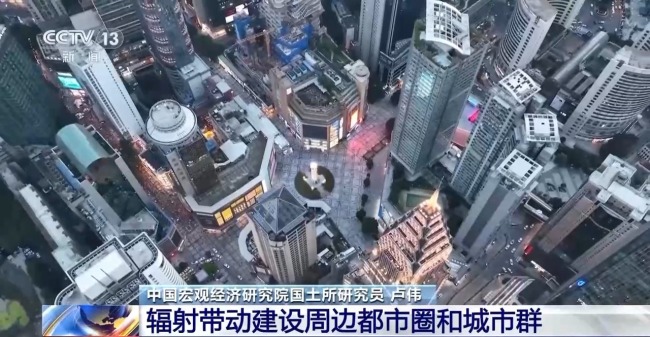
Secondly, the agglomeration and radiation driving effects of super-large cities will be more prominent, and the cultivation and construction of urban agglomerations and urban agglomerations with super-large cities as the core will be accelerated. In the next 10 years, the spatial layout of super-large cities will continue to be optimized, and the collaborative cooperation mechanism with surrounding cities and regions will be continuously improved. Some functions will be relocated and transferred to peripheral cities in an orderly manner. The core and peripheral cities will form an efficient and smooth facility chain, and build an industrial chain and supply chain that is staggered and complementary and orderly division of labor will be further improved.