
China News Service, Guiyang | According to the Guizhou Provincial People's Government Order (No. 222) and the "Guizhou Provincial People's Government's Decision on Abolition and Modification of Some Provincial Government Regulations" published by "Guizhou Daily" on November 11, 2026, Guizhou Province has recently completed the cleanup and amendment of some provincial government regulations, involving the abolition of many old regulations and the modification of the "Guizhou Provincial Real Estate Tax Implementation Rules" and other contents. The relevant documents will be officially announced and implemented from now on.
According to the "Decision of the People's Government of Guizhou Province on Abolition and Modification of Some Provincial Government Regulations", Guizhou Province decided to abolish a number of old regulations, including the "Guizhou Province Port Management Measures", in order to promote the construction of a rule of law government and maintain the unity of the legal system. At the same time, the decision made the second amendment to the "Guizhou Province Property Tax Implementation Rules". Information sources show that the rules were first announced on November 4, 1986, and were revised for the first time in 2010. This time, the latest adjustment was completed in accordance with Provincial Government Order No. 222 on October 17, 2026.
The revised "Guizhou Province Real Estate Tax Implementation Rules" clarifies that real estate taxes are levied in cities, counties, organized towns and industrial and mining areas, and are paid by property owners. In terms of tax calculation basis, the tax calculation is based on the residual value after deducting 30% of the original value of the property. If the property is rented out, the tax calculation basis is based on rental income. The detailed rules stipulate that properties for self-use of units and properties for personal non-business use are exempt from property tax, but properties rented out by tax-exempt units and properties for non-business use are still subject to tax. In addition, real estate taxes are collected annually and paid in installments, and taxpayers must declare and register within 30 days of new construction, purchase, or change of property rights.
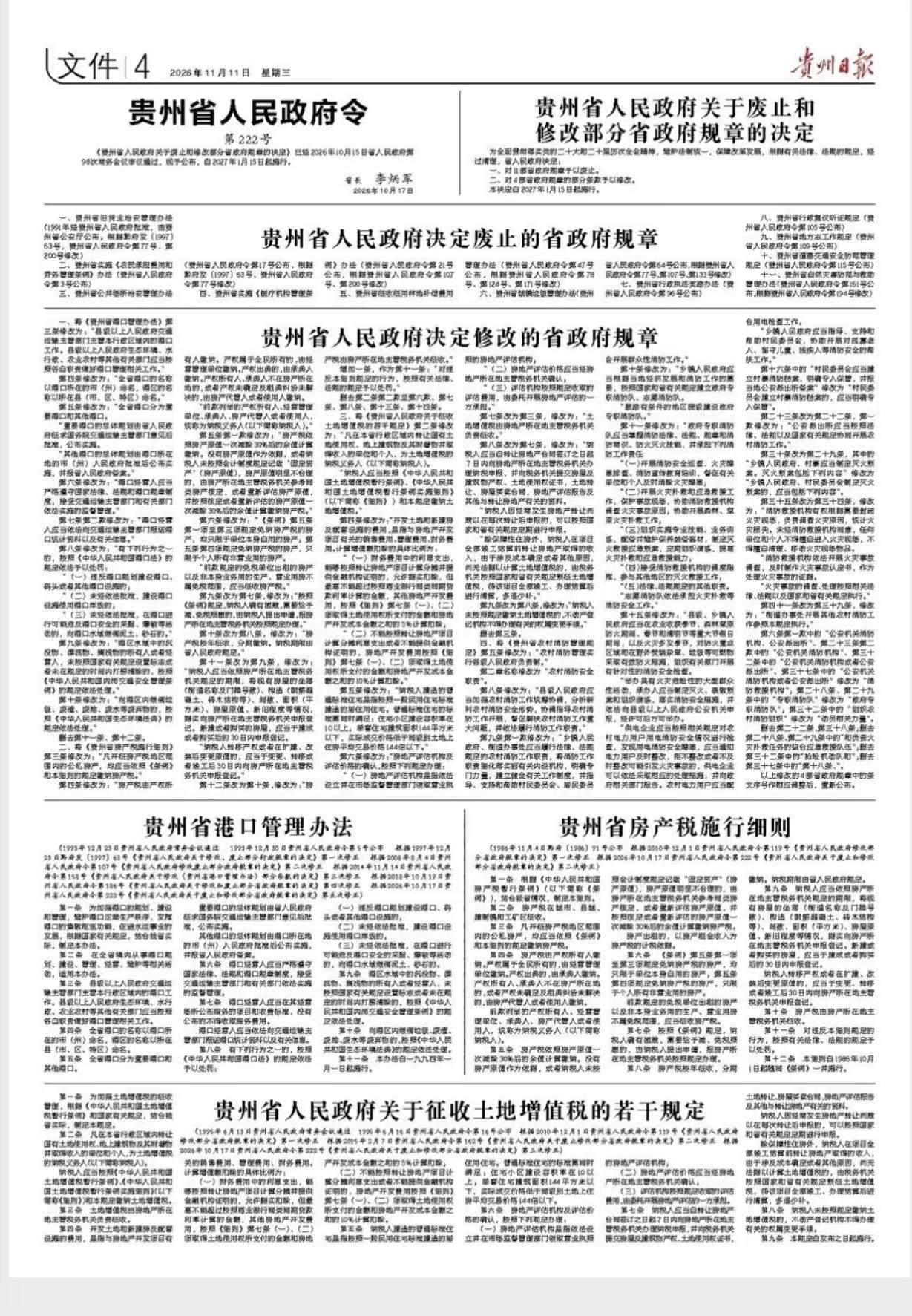
The following is the full text:
Guizhou Province Real Estate Tax Implementation Rules
(Announcement No. 91 of the Guizhou Provincial People's Government [1986] on November 4, 1986. The first amendment was based on the "Decision of the People's Government of Guizhou Province to Amend Some Provincial Government Regulations" on December 1, 2010. The second amendment was based on the "Decision of the People's Government of Guizhou Province on the Abolition and Amending of Some Provincial Government Regulations" on October 17, 2026.)
Article 1 These detailed rules are formulated in accordance with the "Provisional Regulations of the People's Republic of China on Real Estate Tax" (hereinafter referred to as the "Regulations") and in light of the situation in our province.
Article 2 Real estate tax is levied in cities, counties, organized towns and industrial and mining areas.
Article 3 All public and private properties within the area where property tax is levied shall pay property tax in accordance with the provisions of the Regulations and these Detailed Rules.
Article 4 Real estate tax shall be paid by the property owner. If the property rights belong to the whole people, the payment shall be paid by the management unit. If the property rights are deeded, the deedee shall pay the amount. If the property owner or deedee is not located at the location of the property, or if the property rights are not determined and the rental dispute is not resolved, the property custodian or user shall pay.
The property owners, business management units, deeds, real estate custodians or users listed in the preceding paragraph are collectively referred to as taxpayers (hereinafter referred to as taxpayers).
Article 5 Real estate tax is calculated and paid based on the residual value after deducting 30% of the original value of the property. If there is no basis for the original value of the property, or the taxpayer fails to record the "fixed assets" (original value of the property) in accordance with the accounting system, and the original value of the property is obviously unreasonable, the tax authority in charge of the location of the property shall determine it with reference to similar properties, or reassess the original value of the property, and calculate and pay property tax based on the residual value after deducting 30% of the assessed or reassessed original value of the property.
If the property is rented out, the property rental income shall be the basis for calculating property tax.
Article 6 The properties exempted from property tax according to Items 1 to 3 of Article 5 of the "Regulations" are limited to properties used by the unit itself; the properties exempted from property tax according to Item 4 of Article 5 are limited to properties owned by individuals for non-business use.
The properties rented out by the tax-free units specified in the preceding paragraph and the production and business buildings not used for their own business are not within the scope of tax exemption and property tax shall be levied.
Article 7 In accordance with the provisions of the Regulations, if a taxpayer is indeed in difficulty and needs to be provided with tax reduction or exemption, the taxpayer shall submit an application and report it to the competent tax authority where the property is located for processing in accordance with regulations.
Article 8 Real estate tax is collected annually and paid in installments. The tax payment deadline shall be stipulated by the Provincial People's Government.
Article 9 Taxpayers shall, in accordance with the time limit specified by the competent tax authority where the property is located, truthfully report and register the location (street name and house number), structure (reinforced concrete, brick and wood structure, etc.), number of rooms, area (square meters), original value of the house, newness, etc. of the existing house to the competent tax authority where the property is located. A newly built or purchased house must be declared for registration within 30 days of completion or purchase.
If a taxpayer transfers property rights or changes its original value after expansion or modification, it shall declare and register with the competent tax authority where the property is located within 30 days after the change, transfer or completion.
Article 10 Real estate tax shall be levied by the tax authority in charge of the location of the property.
Article 11 Violations of these Rules shall be punished in accordance with relevant laws and regulations.
Article 12 These detailed rules shall come into effect together with the Regulations on October 1, 1986.